Saturday, 10 October 2015

Cork Rosary Churches 2 (Ballyphehane)

The first of the Rosary Churches to be completed was the Church of the Ascension, Gurranabraher, in 1955. The second was completed the following year, the Church of the Assumption, Ballyphehane.

While Gurranabrahar is visibly to the north of the city, Ballyphehane is one of the most successful of the mid-twentieth century planned suburbs to the south of the city and is the 'airport parish'. The names of the streets, after the leaders of Irish independence, reflect the era of the suburb's creation. Thus, for example, the Church of the Assumption is on Pearse Road.

The architect, J.R. Boyd Barrett, a dubliner, began his extensive Cork practice with the amazingly modernist Church of Christ the King, Turner's Cross, in 1931, a little to the east of Ballyphehane. Dr. Coholan, Bishop Lucey's predecessor, had a radical streak despite his arch-conservative reputation. As with his earlier 'Rosary' commission at Gurranabraher, Boyd Barrett was commissioned to design both Church and Parochial houses. He also designed the nearby school. Compared with his earlier work in Turner's Cross and Gurranabrahar, the Church at Ballyphehane is restrained and even conventional basilican form, but in the modern idiom.

For Kildare and Leighlin readers, they may see a similarity of the style with Boyd Barrett's only Church in that Diocese, at Daingean, Co. Offaly (1960). He was also responsible for the extension to the Church in Mountmellick, Co. Laois (1965), and for alterations in Stradbally and Vicarstown, Co. Laois (both 1963).


Queen of the Most Holy Rosary, pray for us!
First published on the St. Conleth's Catholic Heritage Association blog in October, 2010.

Saturday, 3 October 2015

Cork Rosary Churches 1 (Gurranabraher)

I have previously said that Bishop Cornelius Lucey became Bishop of Cork on August 24 1952. By May 29 1953 he announced to a monster meeting in the City Hall that the City needed five new churches around its edge and that each would cost at lease IR£80,000. They were to become known as the Rosary Churches, each dedicated to one of the Glorious Mysteries.

Top of the first list of subscriptions in the July 1953 first issue of the Diocesan Magazine The Fold, another initiative of Bishop Lucey and the first such publication in the Country, was the Munster and Leinster Bank, having given IR£2,500. By the time that the last of the five was completed, the central fund had received IR£209,562 6s 4d and IR£1,300 13s 9d was left over.

When you consider the straightened circumstances of the people of Ireland, and especially the people of Cork, during this time, it is easy to see that these Churches, following initial joy, were carried through by hardship and sacrifice, leading to the glories we see today, truly deserve the title of the Rosary Churches.


A mere two years after the first announcement, the first of the churches to be completed was the Church of the Ascension, Gurranabraher, a well-known landmark in the city, situated majestically above the city.

Queen of the Most Holy Rosary, pray for us!
First published on the St. Conleth's Catholic Heritage Association blog in October, 2010.

Sunday, 23 August 2015

Bishop Cornelius Lucey


Today is the [thirty-fifth] anniversary of the retirement of the Most Reverend Doctor Cornelius Lucey, Bishop of Cork and later of Cork and Ross from 1952-1980. He died in 1982.

In the June-July 81 issue of Africa, he wrote on "Why I left Cork for Turkana":

"Behind my decision to come here as a missionary was the desire to make reparation for my sins while I still had the time. Not that I have been all that bad a sinner at any time in my life, I think. But that I haven't been as good as I could be or even as I should be - far, far from it. And that despite the fact that success and promotion came so easily my way in school, in Maynooth, in the priesthood. Each time at Mass, I too have to confess, "that I have sinned through my own fault in my thoughts and in my words, in what I have done and in what I have failed to do". From him to whom much is given much is expected. What could be fairer? So if we fail to use our talents, or the position we hold and ever so much the more, if we use them wrongly - then we have much to answer for. What better way of escaping punishment in the next life than by punishing ourselves in this life, and doing so expressly to have that much less against us on the Day of Judgement. To do penance - that for me was another reason for not relaxing comfortably at home but opting instead for the Turkana Desert."

His last words were: "I love God; I love the priests; I love the people".

Ecce Sacerdos Magnus qui in diebus illis placuit Deo. Non est inventus similis illi qui conservaret legem Excelsi.

First published on the St. Conleth's Catholic Heritage Association blog in August, 2010.

Thursday, 2 July 2015

A Latin Mass Pilgrimage to Midleton

What could have been more perfect than a pilgrimage to Midleton, Co. Cork, in the Diocese of Cloyne?  We learned that although Midleton is a medieval foundation, but that the foundation of the See at nearby town of Cloyne by St. Colman Mac Léníne takes the history of the place back to the earliest days of Christianity in this part of Ireland.

The present Parish Church of the Most Holy Rosary is a breathtaking example of the neo-gothic style of George Ashlin.  The foundation stone was laid by the great Archbishop Croke of Cashel on 13th May, 1894, and the building was substantially complete by 1895.  Ashlin was also responsible for the Churches in Clonakilty (1880), the Lough (1881), Ballycotton (1900) and St. Colman's Cathedral, Cobh (1878), perhaps the finest neo-gothic church in Ireland.

To quote Bishop Browne, who consecrated the Church on the Feast of the Most Holy Rosary, 7th October, 1928: "This magnificent Church is a credit to the zeal of the clergy and people of Midleton and for all time will stand as a memorial to what this generation and their forefathers did for God."  It stands today as a credit to the Priests and people of Midleton of this and past generations who have preserved intact what had been handed down to them.

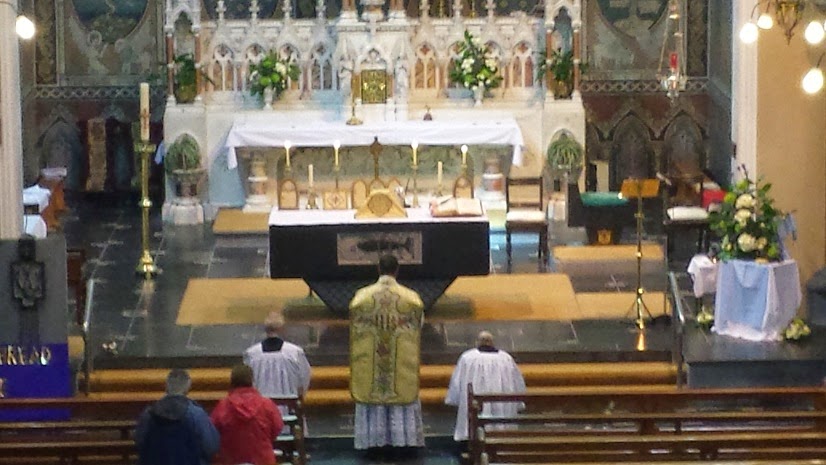
We were blessed to conclude our pilgrimage to Midleton with Holy Mass in the Gregorian Rite in the Parish Church followed by Benediction of the Blessed Sacrament.  It was our second pilgrimage organised to the Diocese of Cloyne, the pilgrimage to Charleville in May having been the first.


Friday, 22 May 2015

Prayer for the Church in Ireland

God of our fathers,
renew us in the faith which is our life and salvation,
the hope which promises forgiveness and interior renewal,
the charity which purifies and opens our hearts
to love you, and in you, each of our brothers and sisters.
Lord Jesus Christ,
may the Church in Ireland renew her age-old commitment
to the education of our young people in the way of truth and goodness, holiness and generous service to society.
Holy Spirit, comforter, advocate and guide,
inspire a new springtime of holiness and apostolic zeal
for the Church in Ireland.
May our sorrow and our tears,
our sincere effort to redress past wrongs,
and our firm purpose of amendment
bear an abundant harvest of grace
for the deepening of the faith
in our families, parishes, schools and communities,
for the spiritual progress of Irish society,
and the growth of charity, justice, joy and peace
within the whole human family.
To you, Triune God,
confident in the loving protection of Mary,
Queen of Ireland, our Mother,
and of Saint Patrick, Saint Brigid and all the saints,
do we entrust ourselves, our children,
and the needs of the Church in Ireland.
Amen.

Pope Benedict XVI
19th March, 2010
Solemnity of St. Joseph

Sunday, 17 May 2015

Pilgrimage to Charleville

It was the first occasion that our Association made a pilgrimage to the Diocese of Cloyne.

Charleville, as its name suggests, was a plantation town, founded by Roger Boyle, Lord Orrery in the year after the restoration of King Charles II.  However, it is as the seed-bed of nationalist poets, prelates and patriots that Charleville is most famous.  It was the birthplace of Seán Mac Domhnaill and Daniel Mannix.  Éamon de Valera walked from the nearby townland of Bruree to school there each day.

The beautiful Church of the Holy Cross is only 110 years old.  Canon Lebocq of the Institute of Christ the King, based in Limerick, was the celebrant of a wonderfully reverent Mass.