From Walsh's Ecclesiastical History of Ireland, from p. 246, Chapter XXVI:
DIOCESE OF CLOYNE AND ROSS
The first of these sees was founded by Saint Colman about the year 580 Colman was of royal extraction by his father's side whose name was Lenine or Lenin and brother to one of the Saints Bridget. He is sometimes surnamed Mitine, whence it is to be inferred that he was a native of the district called Muskerry in the county of Cork. The time of his birth is not known but it was probably about the year 522. He seems to have devoted his early years to the study of poetry and we are assured that he was domestic poet to the prince Aodh Caomh who was raised to the throne of Cashel about the middle of the sixth century and that he was present together with Brendan of Clonfert at his inauguration in Maghfemyn between Cashel and Clonmel. Colman soon after, in accordance with the advice of Saint Brendan, renounced his worldly pursuits and is said to have repaired to the school of St Iarlath at Tuam. Some say that he was the disciple of St. Finbarr of Cork but it is not likely as Colman must have been much older. Colman died according to some in the year 601 or to others in 604. His festival is marked at the 24th of November.
It appears that St Colman became an eminent scholar as he has left a life of St. Senan of Inniscathy written in Irish metre and in an elegant style. He was also a great proficient in the science of the saints.
The see of Ross was founded by St. Fachnan about the year 570. He is also reckoned among the disciples of St. Finbarr but he was prior to that saint. He was surnamed Mongach, i.e., hairy or according to another interpretation MacMongach, son of Mongach. Before he established himself at Ross, Fachnan was abbot of Darinis Maclanfaidh, now Molona, a small island in the river Blackwater, county of Waterford. The school which he founded at Ross was one of the most celebrated and frequented in the south of Ireland. St. Fachnan died at the close of the sixth century and his natalis or the day of his death is marked on the 14th of August. This see has obtained the name of Ross Alithre because of the number of pilgrims who resorted thither. The see of Ross became annexed to that of Cloyne in the eighteenth century and has been again reconstituted by the present illustrious Pontiff Pius IX.
St. Colman, first bishop of Cloyne as already noticed. Of his successors in the see only four are recorded until the coming of the English.
Ó Malvain, bishop of Cloyne died in 1094.
Nehemiah Ó Moriertach flourished in the year 1140 and died about 1149. He is called a plain and modest man excelling all others in wisdom and chastity.
Ó Dubery or Ó Dubrein called abbot of Cluainvama died in 1159.
Ó Flanagan died in 1167.
Mathew sat in 1171 and died about the year 1192 supposed to have been O Mongagh. If so he was legate of Ireland whose legatine authority devolved on Mathew O'Heney, archbishop of Cashel.
Lawrence O'Sullivan who succeeded died at Lismore in 1204.
Daniel died in 1222.
Florence, archdeacon of Belleghac, was elected bishop of Cloyne and at the Pope's request obtained the temporals on the 25th of August, 1224. In the February of the following year the custody of the temporals was granted to Marian, archbishop of Cashel.
Patrick, a Cistercian monk and who was prior of the abbey of Fermoy, was confirmed by the royal assent in the year 1226.
David Mackelley, dean of Cashel, succeeded and was translated to the see of Cashel in 1238.
Alan O'Sullivan succeeded in 1240 was translated to the see of Lismore in 1248.
Daniel, according to Luke Wadding a Franciscan friar, was consecrated bishop of this see in 1249. Upon his election the dean and chapter refused to present him to the king for his approbation but by apostolic mandate directed to the archbishop of Cashel and to the bishops of Killaloe and Lismore proceeded to have him consecrated. The king became so offended at this conduct that he refused to restore him to the temporals until he was prevailed upon by the urgent supplications of some good and religious men, the chapter giving security by patent that they would not in future proceed to elect without the king's licence and that the person elected should present himself to the king for his approbation before he would be consecrated. Daniel died in the beginning of the year 1264 and had been a prelate much esteemed for his virtues devotion and wisdom.
Reginald, who was bishop of Down, obtained the see of Cloyne in 1265. He died about the close of the year 1273.
Alan O'Lonergan, a Franciscan friar, succeeded in 1274. He died in 1283.
Nicholas de Effingham, an Englishman, succeeded in 1284 and obtained the temporals in September of that year. He died in a very advanced age A.D. 1320 having presided upwards of thirty six years.
Maurice Osolehan, archdeacon of Cloyne, succeeded in 1320 and died in 1333 in the thirteenth year after his consecration. In consideration of the poverty of the sees of Cloyne and Cork, King Edward III formed a design to unite them and with that view wrote to the Pope who agreed with the king in the propriety of the measure and accordingly issued a bull to that effect, the original bull being lost.
Richard Wye then bishop of Cloyne applied to Pope Gregory XI to remedy the loss and obtained an exemplification of the bull which John XXII had before granted, but the project of the union was not accomplished until the year 1430, when Jordan, bishop of Cork was promoted to both sees on the death of Adam Pay, bishop of Cloyne, who used every effort to bring this union about.
Showing posts with label St. Colman. Show all posts
Showing posts with label St. Colman. Show all posts
Thursday, 20 October 2016

Tuesday, 24 November 2015
Saint Colman of Cloyne (24th November)

From Fr. Walsh's History of the Irish Hierarchy, (1854), at pages 246 and following:
CHAPTER XXVI
DIOCESE OF CLOYNE AND ROSS
The first of these sees was founded by Saint Colman about the year 580. Colman was of royal extraction by his father's side whose name was Lenine or Lenin and brother to one of the Saints Bridget. He is sometimes surnamed Mitine, whence it is to be inferred that he was a native of the district called Muskerry in the county of Cork. The time of his birth is not known but it was probably about the year 522. He seems to have devoted his early years to the study of poetry and we are assured that he was domestic poet to the prince Aodh Caomh, who was raised to the throne of Cashel about the middle of the sixth century, and that he was present, together with Brendan of Clonfert, at his inauguration in Maghfemyn between Cashel and Clonmel. Colman soon after, in accordance with the advice of Saint Brendan, renounced his worldly pursuits and is said to have repaired to the school of St Jarlath at Tuam. Some say that he was the disciple of St. Finbarr of Cork but it is not likely as Colman must have been much older. Colman died according to some in the year 601 or to others in 604. His festival is marked at the 24th of November. It appears that St. Colman became an eminent scholar as he has left a life of St. Senan of Inniscathy written in Irish metre and in an elegant style. He was also a great proficient in the science of the saints.
[Another account of St. Colman's life is to be found here.]
Thursday, 2 July 2015
A Latin Mass Pilgrimage to Midleton
What could have been more perfect than a pilgrimage to Midleton, Co. Cork, in the Diocese of Cloyne? We learned that although Midleton is a medieval foundation, but that the foundation of the See at nearby town of Cloyne by St. Colman Mac Léníne takes the history of the place back to the earliest days of Christianity in this part of Ireland.
The present Parish Church of the Most Holy Rosary is a breathtaking example of the neo-gothic style of George Ashlin. The foundation stone was laid by the great Archbishop Croke of Cashel on 13th May, 1894, and the building was substantially complete by 1895. Ashlin was also responsible for the Churches in Clonakilty (1880), the Lough (1881), Ballycotton (1900) and St. Colman's Cathedral, Cobh (1878), perhaps the finest neo-gothic church in Ireland.
To quote Bishop Browne, who consecrated the Church on the Feast of the Most Holy Rosary, 7th October, 1928: "This magnificent Church is a credit to the zeal of the clergy and people of Midleton and for all time will stand as a memorial to what this generation and their forefathers did for God." It stands today as a credit to the Priests and people of Midleton of this and past generations who have preserved intact what had been handed down to them.
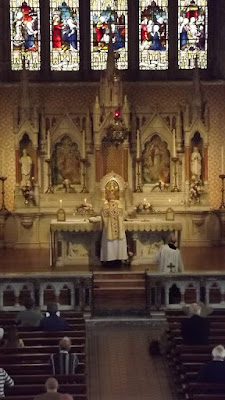
We were blessed to conclude our pilgrimage to Midleton with Holy Mass in the Gregorian Rite in the Parish Church followed by Benediction of the Blessed Sacrament. It was our second pilgrimage organised to the Diocese of Cloyne, the pilgrimage to Charleville in May having been the first.
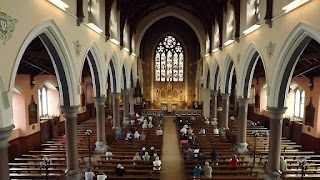




The present Parish Church of the Most Holy Rosary is a breathtaking example of the neo-gothic style of George Ashlin. The foundation stone was laid by the great Archbishop Croke of Cashel on 13th May, 1894, and the building was substantially complete by 1895. Ashlin was also responsible for the Churches in Clonakilty (1880), the Lough (1881), Ballycotton (1900) and St. Colman's Cathedral, Cobh (1878), perhaps the finest neo-gothic church in Ireland.
To quote Bishop Browne, who consecrated the Church on the Feast of the Most Holy Rosary, 7th October, 1928: "This magnificent Church is a credit to the zeal of the clergy and people of Midleton and for all time will stand as a memorial to what this generation and their forefathers did for God." It stands today as a credit to the Priests and people of Midleton of this and past generations who have preserved intact what had been handed down to them.
We were blessed to conclude our pilgrimage to Midleton with Holy Mass in the Gregorian Rite in the Parish Church followed by Benediction of the Blessed Sacrament. It was our second pilgrimage organised to the Diocese of Cloyne, the pilgrimage to Charleville in May having been the first.


Subscribe to:
Posts (Atom)