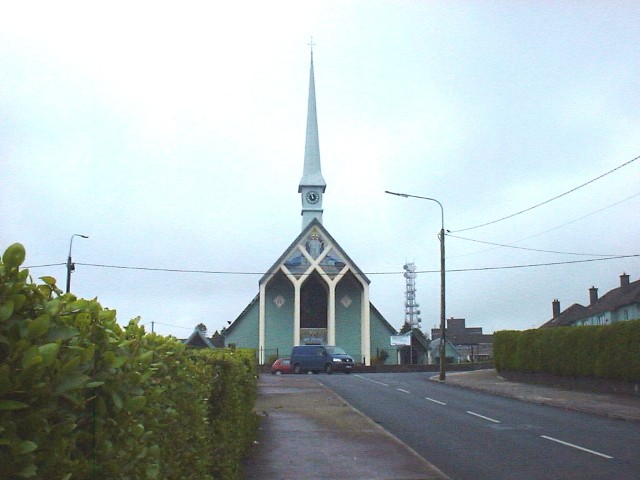
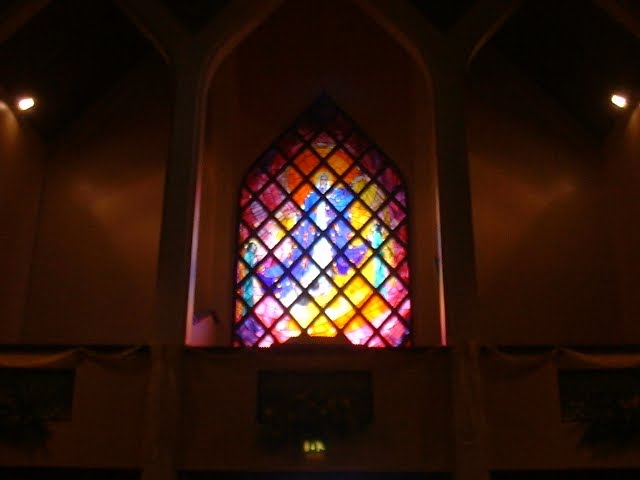
So far as I know, this was the first time in living memory that an Anniversary Mass was organised by her friends for the little mystic of Cork. She deserves our prayers. If she is with Holy God in Heaven she can shower those graces on her devout clients and upon little children like herself and all those who need help to increase their devotion to Holy God in the Blessed Sacrament. On the beautiful feast of Candlemas the members and friends of Blessed Thaddeus Catholic Heritage Association, including some great apostles of Little Nellie, attended a Traditional Latin Mass in the Church of the Resurrection, Farrenree, Cork City, already discussed on this blog as one of the Rosary Churches of Cork. Our deep thanks to the community of Farranree, especially Fr. Walsh and Martha, for making us so welcome.
The Catholic Heritage of Cloyne, Cork and Ross
Showing posts with label Rosary Churches. Show all posts
Wednesday, 3 February 2016
Candlemas and Little Nellie of Holy God
Little Nellie of Holy God is no stranger to the readers of this blog. Last year we made a pilgrimage to the grave of Little Nellie. She featured in our journal in 2014, and in my travel journal along the old railways of Cork back in 2011. She is not (yet) a recognised Saint. The cause for her canonisation has yet to begin - so far as I know - but I know that many in Cork and elsewhere will agree with me in saying subito Santo. May she soon be a canonised Saint. May the cause of her canonisation soon be opened.
So far as I know, this was the first time in living memory that an Anniversary Mass was organised by her friends for the little mystic of Cork. She deserves our prayers. If she is with Holy God in Heaven she can shower those graces on her devout clients and upon little children like herself and all those who need help to increase their devotion to Holy God in the Blessed Sacrament. On the beautiful feast of Candlemas the members and friends of Blessed Thaddeus Catholic Heritage Association, including some great apostles of Little Nellie, attended a Traditional Latin Mass in the Church of the Resurrection, Farrenree, Cork City, already discussed on this blog as one of the Rosary Churches of Cork. Our deep thanks to the community of Farranree, especially Fr. Walsh and Martha, for making us so welcome.
Saturday, 31 October 2015
Cork Rosary Churches 5 (Mayfield)
The final of the Rosary of Churches was completed in that fateful year 1962, only 9 years after the building campaign was announced. It was the Church of Our Lady Crowned at Mayfield. Surely it was a crowning achievement of the Bishop and the people of Cork.
The Parish website gives a detailed history of the building. What is interesting to me is the that the shape of the sanctuary echoes the truest 'modernist' Church in the city at Turner's Cross.
Queen of the Most Holy Rosary, pray for us!
First published on the St. Conleth's Catholic Heritage Association blog in October, 2010.
The Parish website gives a detailed history of the building. What is interesting to me is the that the shape of the sanctuary echoes the truest 'modernist' Church in the city at Turner's Cross.
Queen of the Most Holy Rosary, pray for us!
First published on the St. Conleth's Catholic Heritage Association blog in October, 2010.
Labels:
Bishop Lucey,
Cork,
Rosary Churches
Location:
Mayfield, Cork, Ireland
Saturday, 24 October 2015
Cork Rosary Churches 4 (Dennehy's Cross)
The fourth of the Cork Rosary Churches was completed in 1960 and dedicated to the Descent of the Holy Ghost it is sometimes also known as the Church of the Holy Spirit, Dennehy's Cross. It was the seventh new Church in Cork, of a total of eleven, designed by J.R. Boyd Barrett and the third of the four Rosary Churches built to his design. It is to the west of the Church of the Assumption, Ballyphehane, and to the south of the Church of the Ascension, Gurranabraher.
To my eye, it is the best of the Rosary Churches and certainly the most conventional. Compared with Boyd Barrett's first Cork Church at Turner's Cross it represents a great retreat from modernism. In materials and basic elements it is very like the Franciscan Church in Liberty Street completed in 1955, just two years before construction of the Church of the Descent of the Holy Ghost began, except for neo-baroque elements that the single central dome is more articulated and the facade is faced in stone while the body of the Church is completed in brick.
The Parish's website states the following: "Our church is situated at the junction of two very busy thoroughfares, Model Farm Road and Wilton Road in the western suburbs of Cork city. Built as one of a rosary of churches on the edge of the city, as it was at that time, it is dedicated to the Holy Spirit.
Built on an old quarry and some adjoining pasture land, the site was blessed by the Bishop of Cork, Dr. Cornelius Lucey in November 1956 and four years later the site had been transformed: a large brick and limestone church with its distinctive dome rising 140 feet [42.67m], designed by J.R.Boyd Barrett and built by Pat Shea & Co., now dominated by the surrounding area.
The Church of Descent of the Holy Spirit, with a seating capacity for 1,100, was blessed and opened on Sunday, 25th September 1960, the feast of St. Finbarr, patron saint of the diocese, by Dr. Lucey
The dedication of the Church of the Holy Spirit, the first in Ireland, was highlighted by the magnificent Pentecost altar mosaic, which was designed and executed by the Italian artist Romeo Battistella, who was attached to International Mosaics of Roscommon.
The church is neo-classical in style with a plan of a Latin cross with nave and transepts, 193 feet [58.83m] long and 98 feet [29.87m] wide. A large bronze lantern stands on top of the copper-sheeted dome, surmounted by a 24-foot [7.32m] high cross. The design is reputed to have been influenced by the churches Dr. Lucey had seen during his visit to the Eucharistic Congress in Spain.
The sanctuary mosaic depicts the events of Pentecost, Acts.2: 1-4"
Queen of the Most Holy Rosary, pray for us!
First published on the St. Conleth's Catholic Heritage Association blog in October, 2010.
To my eye, it is the best of the Rosary Churches and certainly the most conventional. Compared with Boyd Barrett's first Cork Church at Turner's Cross it represents a great retreat from modernism. In materials and basic elements it is very like the Franciscan Church in Liberty Street completed in 1955, just two years before construction of the Church of the Descent of the Holy Ghost began, except for neo-baroque elements that the single central dome is more articulated and the facade is faced in stone while the body of the Church is completed in brick.
The Parish's website states the following: "Our church is situated at the junction of two very busy thoroughfares, Model Farm Road and Wilton Road in the western suburbs of Cork city. Built as one of a rosary of churches on the edge of the city, as it was at that time, it is dedicated to the Holy Spirit.
Built on an old quarry and some adjoining pasture land, the site was blessed by the Bishop of Cork, Dr. Cornelius Lucey in November 1956 and four years later the site had been transformed: a large brick and limestone church with its distinctive dome rising 140 feet [42.67m], designed by J.R.Boyd Barrett and built by Pat Shea & Co., now dominated by the surrounding area.
The Church of Descent of the Holy Spirit, with a seating capacity for 1,100, was blessed and opened on Sunday, 25th September 1960, the feast of St. Finbarr, patron saint of the diocese, by Dr. Lucey
The dedication of the Church of the Holy Spirit, the first in Ireland, was highlighted by the magnificent Pentecost altar mosaic, which was designed and executed by the Italian artist Romeo Battistella, who was attached to International Mosaics of Roscommon.
The church is neo-classical in style with a plan of a Latin cross with nave and transepts, 193 feet [58.83m] long and 98 feet [29.87m] wide. A large bronze lantern stands on top of the copper-sheeted dome, surmounted by a 24-foot [7.32m] high cross. The design is reputed to have been influenced by the churches Dr. Lucey had seen during his visit to the Eucharistic Congress in Spain.
The sanctuary mosaic depicts the events of Pentecost, Acts.2: 1-4"
Queen of the Most Holy Rosary, pray for us!
First published on the St. Conleth's Catholic Heritage Association blog in October, 2010.
Labels:
Bishop Lucey,
Cork,
Rosary Churches
Location:
Dennehys Cross, Cork, Ireland
Saturday, 17 October 2015
Cork Rosary Churches 3 (Farranree)
In 1958 the third of the Rosary of Churches on the outskirts of Cork City was built. It was the Church of the Resurrection, on what was then known as Spangle Hill and has now become Farranree. It is another of the 'hilltop' Rosary Churches, like Mayfield to the east and Gurranabraher to the south. Not the most elegant sight to my eye but it is notable all the same. As you stand on Patrick's Bridge and look to the west and the north it crowns the heights overlooking the city. A festival of flowers marked the golden jubilee a couple of years ago.
Fitzgerald Smith and Company, the Cork based architects on the project designed what was described as a basilica plan freely interpreted with an upward thrust intended to be symbolic of the Ressurection culminating in a 'fleche' or thin rooftop spire. At the blessing of the Church Bishop Lucey asked, is it too much to hope that as Christ's Ressurection began his glorious and triumphant reign after Calvary, so many this new Church of the Ressurection may begin for Cork an new era in which emigration and poverty and lack of housing and neglect of God's Commandments will be no more, in which religion and family life, trade, industry and the arts will flourish, in which he that sitteth on the throne can say of Cork: "Behold I have made thee and they people new according to My own Heart"?
The consacration was performed by the great Cardinal Cushing of Boston, whose connection with the Diocese of Cork and Ross, especially in connection with the Rosary Churches, is the stuff of legend.
Queen of the Most Holy Rosary, pray for us!
First published on the St. Conleth's Catholic Heritage Association blog in October, 2010.
Fitzgerald Smith and Company, the Cork based architects on the project designed what was described as a basilica plan freely interpreted with an upward thrust intended to be symbolic of the Ressurection culminating in a 'fleche' or thin rooftop spire. At the blessing of the Church Bishop Lucey asked, is it too much to hope that as Christ's Ressurection began his glorious and triumphant reign after Calvary, so many this new Church of the Ressurection may begin for Cork an new era in which emigration and poverty and lack of housing and neglect of God's Commandments will be no more, in which religion and family life, trade, industry and the arts will flourish, in which he that sitteth on the throne can say of Cork: "Behold I have made thee and they people new according to My own Heart"?
The consacration was performed by the great Cardinal Cushing of Boston, whose connection with the Diocese of Cork and Ross, especially in connection with the Rosary Churches, is the stuff of legend.
Queen of the Most Holy Rosary, pray for us!
First published on the St. Conleth's Catholic Heritage Association blog in October, 2010.
Labels:
Bishop Lucey,
Cork,
Rosary Churches
Location:
Farranree, Cork, Ireland
Saturday, 10 October 2015
Cork Rosary Churches 2 (Ballyphehane)
The first of the Rosary Churches to be completed was the Church of the Ascension, Gurranabraher, in 1955. The second was completed the following year, the Church of the Assumption, Ballyphehane.
While Gurranabrahar is visibly to the north of the city, Ballyphehane is one of the most successful of the mid-twentieth century planned suburbs to the south of the city and is the 'airport parish'. The names of the streets, after the leaders of Irish independence, reflect the era of the suburb's creation. Thus, for example, the Church of the Assumption is on Pearse Road.
The architect, J.R. Boyd Barrett, a dubliner, began his extensive Cork practice with the amazingly modernist Church of Christ the King, Turner's Cross, in 1931, a little to the east of Ballyphehane. Dr. Coholan, Bishop Lucey's predecessor, had a radical streak despite his arch-conservative reputation. As with his earlier 'Rosary' commission at Gurranabraher, Boyd Barrett was commissioned to design both Church and Parochial houses. He also designed the nearby school. Compared with his earlier work in Turner's Cross and Gurranabrahar, the Church at Ballyphehane is restrained and even conventional basilican form, but in the modern idiom.
For Kildare and Leighlin readers, they may see a similarity of the style with Boyd Barrett's only Church in that Diocese, at Daingean, Co. Offaly (1960). He was also responsible for the extension to the Church in Mountmellick, Co. Laois (1965), and for alterations in Stradbally and Vicarstown, Co. Laois (both 1963).
Queen of the Most Holy Rosary, pray for us!
First published on the St. Conleth's Catholic Heritage Association blog in October, 2010.
While Gurranabrahar is visibly to the north of the city, Ballyphehane is one of the most successful of the mid-twentieth century planned suburbs to the south of the city and is the 'airport parish'. The names of the streets, after the leaders of Irish independence, reflect the era of the suburb's creation. Thus, for example, the Church of the Assumption is on Pearse Road.
The architect, J.R. Boyd Barrett, a dubliner, began his extensive Cork practice with the amazingly modernist Church of Christ the King, Turner's Cross, in 1931, a little to the east of Ballyphehane. Dr. Coholan, Bishop Lucey's predecessor, had a radical streak despite his arch-conservative reputation. As with his earlier 'Rosary' commission at Gurranabraher, Boyd Barrett was commissioned to design both Church and Parochial houses. He also designed the nearby school. Compared with his earlier work in Turner's Cross and Gurranabrahar, the Church at Ballyphehane is restrained and even conventional basilican form, but in the modern idiom.
For Kildare and Leighlin readers, they may see a similarity of the style with Boyd Barrett's only Church in that Diocese, at Daingean, Co. Offaly (1960). He was also responsible for the extension to the Church in Mountmellick, Co. Laois (1965), and for alterations in Stradbally and Vicarstown, Co. Laois (both 1963).
Queen of the Most Holy Rosary, pray for us!
First published on the St. Conleth's Catholic Heritage Association blog in October, 2010.
Labels:
Bishop Lucey,
Cork,
Rosary Churches
Location:
Ballyphehane, Cork, Ireland
Saturday, 3 October 2015
Cork Rosary Churches 1 (Gurranabraher)
I have previously said that Bishop Cornelius Lucey became Bishop of Cork on August 24 1952. By May 29 1953 he announced to a monster meeting in the City Hall that the City needed five new churches around its edge and that each would cost at lease IR£80,000. They were to become known as the Rosary Churches, each dedicated to one of the Glorious Mysteries.
Top of the first list of subscriptions in the July 1953 first issue of the Diocesan Magazine The Fold, another initiative of Bishop Lucey and the first such publication in the Country, was the Munster and Leinster Bank, having given IR£2,500. By the time that the last of the five was completed, the central fund had received IR£209,562 6s 4d and IR£1,300 13s 9d was left over.
When you consider the straightened circumstances of the people of Ireland, and especially the people of Cork, during this time, it is easy to see that these Churches, following initial joy, were carried through by hardship and sacrifice, leading to the glories we see today, truly deserve the title of the Rosary Churches.
A mere two years after the first announcement, the first of the churches to be completed was the Church of the Ascension, Gurranabraher, a well-known landmark in the city, situated majestically above the city.
Queen of the Most Holy Rosary, pray for us!
First published on the St. Conleth's Catholic Heritage Association blog in October, 2010.
Top of the first list of subscriptions in the July 1953 first issue of the Diocesan Magazine The Fold, another initiative of Bishop Lucey and the first such publication in the Country, was the Munster and Leinster Bank, having given IR£2,500. By the time that the last of the five was completed, the central fund had received IR£209,562 6s 4d and IR£1,300 13s 9d was left over.
When you consider the straightened circumstances of the people of Ireland, and especially the people of Cork, during this time, it is easy to see that these Churches, following initial joy, were carried through by hardship and sacrifice, leading to the glories we see today, truly deserve the title of the Rosary Churches.
A mere two years after the first announcement, the first of the churches to be completed was the Church of the Ascension, Gurranabraher, a well-known landmark in the city, situated majestically above the city.
Queen of the Most Holy Rosary, pray for us!
First published on the St. Conleth's Catholic Heritage Association blog in October, 2010.
Labels:
Bishop Lucey,
Cork,
Rosary Churches
Location:
Gurranabraher, Cork, Ireland
Thursday, 2 July 2015
A Latin Mass Pilgrimage to Midleton
What could have been more perfect than a pilgrimage to Midleton, Co. Cork, in the Diocese of Cloyne? We learned that although Midleton is a medieval foundation, but that the foundation of the See at nearby town of Cloyne by St. Colman Mac Léníne takes the history of the place back to the earliest days of Christianity in this part of Ireland.
The present Parish Church of the Most Holy Rosary is a breathtaking example of the neo-gothic style of George Ashlin. The foundation stone was laid by the great Archbishop Croke of Cashel on 13th May, 1894, and the building was substantially complete by 1895. Ashlin was also responsible for the Churches in Clonakilty (1880), the Lough (1881), Ballycotton (1900) and St. Colman's Cathedral, Cobh (1878), perhaps the finest neo-gothic church in Ireland.
To quote Bishop Browne, who consecrated the Church on the Feast of the Most Holy Rosary, 7th October, 1928: "This magnificent Church is a credit to the zeal of the clergy and people of Midleton and for all time will stand as a memorial to what this generation and their forefathers did for God." It stands today as a credit to the Priests and people of Midleton of this and past generations who have preserved intact what had been handed down to them.
We were blessed to conclude our pilgrimage to Midleton with Holy Mass in the Gregorian Rite in the Parish Church followed by Benediction of the Blessed Sacrament. It was our second pilgrimage organised to the Diocese of Cloyne, the pilgrimage to Charleville in May having been the first.
The present Parish Church of the Most Holy Rosary is a breathtaking example of the neo-gothic style of George Ashlin. The foundation stone was laid by the great Archbishop Croke of Cashel on 13th May, 1894, and the building was substantially complete by 1895. Ashlin was also responsible for the Churches in Clonakilty (1880), the Lough (1881), Ballycotton (1900) and St. Colman's Cathedral, Cobh (1878), perhaps the finest neo-gothic church in Ireland.
To quote Bishop Browne, who consecrated the Church on the Feast of the Most Holy Rosary, 7th October, 1928: "This magnificent Church is a credit to the zeal of the clergy and people of Midleton and for all time will stand as a memorial to what this generation and their forefathers did for God." It stands today as a credit to the Priests and people of Midleton of this and past generations who have preserved intact what had been handed down to them.
We were blessed to conclude our pilgrimage to Midleton with Holy Mass in the Gregorian Rite in the Parish Church followed by Benediction of the Blessed Sacrament. It was our second pilgrimage organised to the Diocese of Cloyne, the pilgrimage to Charleville in May having been the first.
Saturday, 30 May 2015
Subscribe to:
Comments (Atom)