Showing posts with label Cloyne. Show all posts

Tuesday, 13 June 2017

St. Carthage and Spike Island

The River Lee flows from Gougane Barra through the City of Cork, as a sort of perpetual re-enactment of the religious lift of the great Saint Finbar, whose monastery in Gougane was followed by his monastery and great school in Cork, where he spent the last seventeen years of his earthly life, until his holy death on 25th September, 623.

However, the Lee flows on past Cork into the ocean, just as Finbar's soul flowed on into eternal life - there is deep meaning in the flowing of rivers!  As the Lee passes into its estuary, the harbour of Cork, it passes Spike Island, where Little Nellie of Holy God lived and where her mother died.  Nellie had been born in Waterford, and it was another saint associated with Waterford who first sanctified Spike Island.

St. Carthage was born of a noble family of Kerry.  He founded a monastery at Rahan in Offaly but was forcibly expelled with all his monks on account of the jealousy of local clerics about the year 634.  Travelling south, he obtained a cure for the King of Munster, Cathal Mac Aodh, and was granted the islands in Cork harbour for a monastery.  He seems to have resided there only a year but to have left a small monastic community there, including the three sons of Nascann, Bishop Goban, Sraphan the Priest and Saint Laserian.  He then proceeded to Lismore, where he established his great monastery and school that was to form the basis of the present Diocese. 

For this reason, even at the time of the Synod of Rathbreasail in 1110, it appears that the Diocese of Lismore extended as far as the Diocese of Cork and encompassed the Diocese of Cloyne.  I cannot account for the 'disappearance' of the Diocese of St. Colman Mac Léine (522-604) for the period of four and a half centuries.  There is also some doubt as to whether Spike Island itself was included in the Diocese of Lismore or of Cork at the time.  Certainly, a decretal of Innocent III of 1199 includes Spike Island in the Diocese of Cork.  There was certainly a Bishop in Cloyne by 1148 and the Diocese is listed among the Dioceses of Ireland at the Synod of Kells in 1152.  Even as late as the 16th Century, the collection records include Kilworth in the Diocese of Lismore.

Returning to the Holy Island of Spike, the Martyrology of Tallaght recordes a St. Ruisen or Lappan in connection with Spike Island.  He seems to be one with the Bishop of Cork, second successor of St. Finbar, who died in 685 or 687.  The monastery was still extant in 821, when the death of Sealbhach, the abbot, is recorded.

The church and island of "Ynespic" was granted by Henry II to Milo de Cogan in 1177 and later fell to St. Thomas' Abbey in Dublin and at the time of the despoilation of the Religious Houses of Ireland in 1541, it was under the control of St. Catherine's, the Augustinian House in Waterford.

Thursday, 20 April 2017

Latin Mass in Ballyhea for Easter Monday

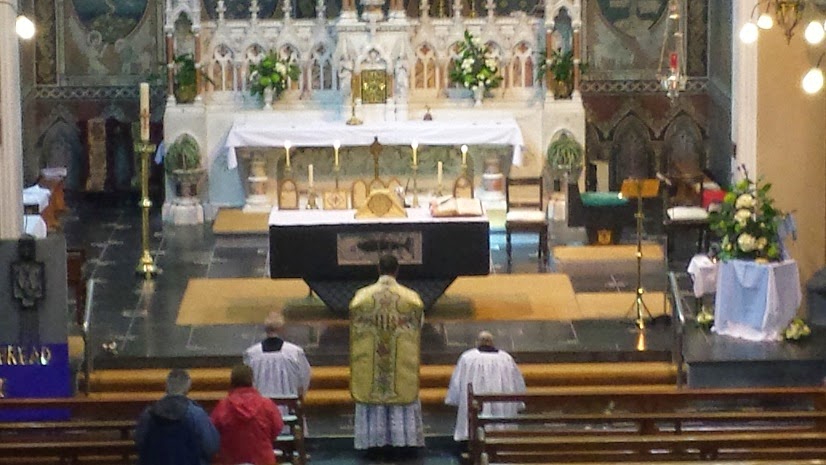
Ballyhea lies just south of Charleville, Co. Cork, in the lea of the Ballyhoura Mountains and along the waters of the Awbeg River, the tributary of the Blackwater once immortalised by Edmund Spenser as "gentle Mullagh".  On Easter Monday morning, some members and friends made their way to the Parish Church of St. Mary for the offering of the almost monthly Traditional Latin Mass there.


Wednesday, 23 November 2016

Ecclesiastical History Diocese of Cloyne and Ross - 2.

From Walsh's Ecclesiastical History of Ireland, from p. 246, Chapter XXVI:

Diocese of Cloyne (Contd...)

John de Cumba, a Cistercian monk of the abbey of Combe in Warwickshire, succeeded in 1335 by provision of the Pope and obtained the temporals in the same year.
John Brid, abbot of the Cistercian abbey of Louth Park in Lincolnshire, England, succeeded. Nothing more known of this prelate.
John Whittock succeeded in 1351, was dean of Cloyne when chosen to the see, was confirmed by the Pope and obtained the temporals from the king having renounced all clauses in the bull of the Pontiff prejudicial to the royal interest. John died in February 1361.
John de Swafham, a Carmelite friar of the abbey of Lyn in the county of Norfolk and doctor of divinity of the university of Cambridge, was consecrated bishop of Cloyne in 1363. John was translated to the see of Bangor in Wales on the 2d of July, 1376, by Pope Gregory XI as a recompense for his great labors against the Wickliffites.
Richard Wye, a Carmelite friar was advanced to the see of Cloyne by provision of Pope Gregory XI and obtained the temporals in the year 1376. Having committed some misdemeanors he was excommunicated in 1380.  He fled into England and was deprived in 1394. Notwithstanding his deprivation he took upon himself to act as bishop and the year following King Richard II, who was then at Waterford, ordered him to be arrested and given in custody to Peter Hackett, archbishop of Cashel.
Gerald Canton, an Augustin hermit and vicar general of that order in Ireland, was promoted to the see of Cloyne by provision of Pope Boniface IX and was restored to the temporals in November, 1394. Gerald was sitting on the 14th of May, 1407.
Adam Pay or Pye succeeded. Was sitting in 1421 and in that year had disputes with the bishop of Cork in a parliament assembled at Dublin about the union of Cork with the diocese of Cloyne.  The parliament took no cognizance of the matter, as it properly belonged to the Pope. This prelate died in the year 1430.
Jordan succeeded to the see of Cloyne united to that of Cork in 1430.

Diocese of Ross

Its founder and first bishop St. Fachnan Mongach already noticed.
Donegal MacFolact whom O'Flaherty makes the twenty seventh bishop of Ross after St Fachnan. He quotes the book of Leacan as his authority:

"Dongalus a Fachtna ter mums episcopus extat Lugadia de Gente dedit cui Russia mitram."

This distich has been translated by the Rev Mr Dunkin Hail:

"Happy Ross that could produce thrice nine All-mitred sages of Lugadia's line From Fachnan crowned with everlasting praise Down to the date of pious Dungal's days."

Benedict was bishop of Ross in 1172 and sat about eighteen years after Maurice who succeeded 1190 died in 1196.
Daniel, a secular priest who obtained the see by forged letters to the Pope, succeeded and was consecrated at Rome by the bishop of Albano in the year 1197. Daniel forged several letters from bishops and thus deluded the Pope to confirm him in the see of Ross.
Florence and another monk of Ross having repaired to Rome each of them asserting his claim to the diocese, the former accused Daniel of deception in procuring his own consecration. The Pontiff Celestine committed the examination of the claims of those three candidates to Mathew O'Heney, archbishop of Cashel, and to Charles O'Heney, bishop of Killaloe, with instructions if they found Daniel canonically elected to establish him in the possession of the see, if otherwise that they should investigate the claims of the two monks and declare the one chosen according to the canons the bishop of Ross. Having proceeded to enquire, the delegates cited Daniel to appear on three occasions, to which Daniel paid no attention. They then enquired into the claims of the other parties and finding that the opponent of Florence was not even put in nomination and it appearing that Florence was canonically elected who had the concurrent testimonials of the clergy and people of Ross, of the king, of Cork, and moreover the prelates of the province, they confirmed the said Florence, by apostolic authority. During those proceedings, Pope Celestine died and Innocent III was advanced to the papal chair and Daniel again repaired to Rome, where he endeavored to support his cause as he began it, by fraud and falsehood. He was at length ousted and his competitor Florence established in his see. Florence succeeded, was sitting in 1210 in which year he was suspended by the Pope from the power of ordaining for having conferred three orders in one day on William, bishop elect of Emly. Florence died in the year 1222.
Robert or Richard who succeeded Florence was sitting in 1225. Florence O Cloghena resigned in 1252.
Maurice, a minorite and chantor of Cloyne, succeeded in 1253. Maurice obtained licence from the Pope to resign and in 1269 the archbishop of Cashel was empowered to receive his cession of the diocese by Pope Clement IV and absolve him from all obligations to the church of Ross.  The Pontiff in his letter added that Maurice was incompetent to govern the see of Ross both from his want of learning and the weakness of his constitution.
Walter O'Mitchain, a Franciscan friar, succeeded in 1269, sat five years and died in 1274.
Peter O'Hullican, a Cistercian monk, was consecrated in 1275 and also obtained the temporals. Peter died in 1290.
Lawrence, a canon of Ross, was elected in 1290. He sat nineteen years, died in 1309, and was buried in his own church.
Mathew O'Fin, who was an abbot, was chosen by the dean and chapter on the 8th of March, 1309. Mathew recovered several possessions of his see which had been unjustly usurped by Thomas Barret and Philip de Carew. The king, thinking there was collusion in the affair in order that the statutes of mortmain might be avoided, ordered another inquest to try the case and the jury found in favor of the bishop. Mathew died in the year 1330.
Lawrence O'Holdecan or Hullucan succeeded in 1331 was confirmed by the dean and chapter of Cashel as that see was then vacant. Lawrence only presided four years.
Denis was consecrated in 1336. Denis died in 1377.
Bernard O'Connor, a Franciscan friar, succeeded in 1378 by provision of the Pope and having sworn allegiance to the king obtained the temporals.
Stephen Brown, a Carmelite, succeeded in 1378 by provision of Pope Boniface IX and was restored to the temporals on the 6th of May, 1402.
Mathew, bishop of Ross, died about the year 1418.
Walter Formay, a Franciscan friar and doctor of divinity, was promoted to the see of Ross by Pope Martin V in November, 1418.
Cornelius MacElchade, a Franciscan friar, was promoted instead of John Bloxmonch, a Carmelite who neglected to expedite his provisional letters, by the Pope to the see of Ross on the 18th of August, 1426.
Thady succeeded as bishop of Ross and was sitting in January 1488, died soon after.
Odo or Hugh succeeded in 1489 and sat only five years.
Edmond Courcey, a minorite and professor of divinity, who had been consecrated bishop of Clogher in June, 1484, was translated to the see of Ross in September, 1494. Edmond died in a very advanced age on the 14th of March ,1518, and was buried in a monastery of his own order at Timoleague in the county of Cork, of which he built the steeple, dormitory, infirmary and library.
John Imurily, a Cistercian of the abbey of Maur in the county of Cork and afterwards abbot of that house, succeeded to the see of Ross in the year, 1519. He died on the 9th of January same year and was buried in the monastery of Timoleague, having assumed the Franciscan habit.
Bonaventure, a Spaniard, succeeded and was sitting in 1523.

Thursday, 20 October 2016

Ecclesiastical History Diocese of Cloyne and Ross - 1.

From Walsh's Ecclesiastical History of Ireland, from p. 246, Chapter XXVI:

DIOCESE OF CLOYNE AND ROSS

The first of these sees was founded by Saint Colman about the year 580 Colman was of royal extraction by his father's side whose name was Lenine or Lenin and brother to one of the Saints Bridget. He is sometimes surnamed Mitine, whence it is to be inferred that he was a native of the district called Muskerry in the county of Cork. The time of his birth is not known but it was probably about the year 522. He seems to have devoted his early years to the study of poetry and we are assured that he was domestic poet to the prince Aodh Caomh who was raised to the throne of Cashel about the middle of the sixth century and that he was present together with Brendan of Clonfert at his inauguration in Maghfemyn between Cashel and Clonmel. Colman soon after, in accordance with the advice of Saint Brendan, renounced his worldly pursuits and is said to have repaired to the school of St Iarlath at Tuam. Some say that he was the disciple of St. Finbarr of Cork but it is not likely as Colman must have been much older. Colman died according to some in the year 601 or to others in 604. His festival is marked at the 24th of November.

It appears that St Colman became an eminent scholar as he has left a life of St. Senan of Inniscathy written in Irish metre and in an elegant style. He was also a great proficient in the science of the saints.

The see of Ross was founded by St. Fachnan about the year 570. He is also reckoned among the disciples of St. Finbarr but he was prior to that saint. He was surnamed Mongach, i.e., hairy or according to another interpretation MacMongach, son of Mongach. Before he established himself at Ross, Fachnan was abbot of Darinis Maclanfaidh, now Molona, a small island in the river Blackwater, county of Waterford. The school which he founded at Ross was one of the most celebrated and frequented in the south of Ireland. St. Fachnan died at the close of the sixth century and his natalis or the day of his death is marked on the 14th of August. This see has obtained the name of Ross Alithre because of the number of pilgrims who resorted thither. The see of Ross became annexed to that of Cloyne in the eighteenth century and has been again reconstituted by the present illustrious Pontiff Pius IX.

St. Colman, first bishop of Cloyne as already noticed. Of his successors in the see only four are recorded until the coming of the English.

Ó Malvain, bishop of Cloyne died in 1094.
Nehemiah Ó Moriertach flourished in the year 1140 and died about 1149. He is called a plain and modest man excelling all others in wisdom and chastity.
Ó Dubery or Ó Dubrein called abbot of Cluainvama died in 1159.
Ó Flanagan died in 1167.

Mathew sat in 1171 and died about the year 1192 supposed to have been O Mongagh. If so he was legate of Ireland whose legatine authority devolved on Mathew O'Heney, archbishop of Cashel.
Lawrence O'Sullivan who succeeded died at Lismore in 1204. Daniel died in 1222.
Florence, archdeacon of Belleghac, was elected bishop of Cloyne and at the Pope's request obtained the temporals on the 25th of August, 1224. In the February of the following year the custody of the temporals was granted to Marian, archbishop of Cashel.
Patrick, a Cistercian monk and who was prior of the abbey of Fermoy, was confirmed by the royal assent in the year 1226.
David Mackelley, dean of Cashel, succeeded and was translated to the see of Cashel in 1238.
Alan O'Sullivan succeeded in 1240 was translated to the see of Lismore in 1248.
Daniel, according to Luke Wadding a Franciscan friar, was consecrated bishop of this see in 1249. Upon his election the dean and chapter refused to present him to the king for his approbation but by apostolic mandate directed to the archbishop of Cashel and to the bishops of Killaloe and Lismore proceeded to have him consecrated. The king became so offended at this conduct that he refused to restore him to the temporals until he was prevailed upon by the urgent supplications of some good and religious men, the chapter giving security by patent that they would not in future proceed to elect without the king's licence and that the person elected should present himself to the king for his approbation before he would be consecrated. Daniel died in the beginning of the year 1264 and had been a prelate much esteemed for his virtues devotion and wisdom.
Reginald, who was bishop of Down, obtained the see of Cloyne in 1265. He died about the close of the year 1273.
Alan O'Lonergan, a Franciscan friar, succeeded in 1274. He died in 1283.
Nicholas de Effingham, an Englishman, succeeded in 1284 and obtained the temporals in September of that year. He died in a very advanced age A.D. 1320 having presided upwards of thirty six years.
Maurice Osolehan, archdeacon of Cloyne, succeeded in 1320 and died in 1333 in the thirteenth year after his consecration. In consideration of the poverty of the sees of Cloyne and Cork, King Edward III formed a design to unite them and with that view wrote to the Pope who agreed with the king in the propriety of the measure and accordingly issued a bull to that effect, the original bull being lost.

Richard Wye then bishop of Cloyne applied to Pope Gregory XI to remedy the loss and obtained an exemplification of the bull which John XXII had before granted, but the project of the union was not accomplished until the year 1430, when Jordan, bishop of Cork was promoted to both sees on the death of Adam Pay, bishop of Cloyne, who used every effort to bring this union about.

Tuesday, 24 November 2015

Saint Colman of Cloyne (24th November)


From Fr. Walsh's History of the Irish Hierarchy, (1854), at pages 246 and following:

CHAPTER XXVI 
DIOCESE OF CLOYNE AND ROSS 

The first of these sees was founded by Saint Colman about the year 580. Colman was of royal extraction by his father's side whose name was Lenine or Lenin and brother to one of the Saints Bridget. He is sometimes surnamed Mitine, whence it is to be inferred that he was a native of the district called Muskerry in the county of Cork. The time of his birth is not known but it was probably about the year 522. He seems to have devoted his early years to the study of poetry and we are assured that he was domestic poet to the prince Aodh Caomh, who was raised to the throne of Cashel about the middle of the sixth century, and that he was present, together with Brendan of Clonfert, at his inauguration in Maghfemyn between Cashel and Clonmel. Colman soon after, in accordance with the advice of Saint Brendan, renounced his worldly pursuits and is said to have repaired to the school of St Jarlath at Tuam. Some say that he was the disciple of St. Finbarr of Cork but it is not likely as Colman must have been much older. Colman died according to some in the year 601 or to others in 604. His festival is marked at the 24th of November. It appears that St. Colman became an eminent scholar as he has left a life of St. Senan of Inniscathy written in Irish metre and in an elegant style. He was also a great proficient in the science of the saints.

[Another account of St. Colman's life is to be found here.]

Saturday, 31 October 2015

Pilgrimage in honour of Blessed Thaddeus McCarthy

The members and friends of Blessed Thaddeus McCarthy's Catholic Heritage Association made a pilgrimage again this year to the Cathedral of Ss. Mary and Anne in Cork City for a Traditional Latin Mass. The report of the Mass last year can be found here. Several accounts of the life of Blessed Thaddeus can be found here, here and here. One of the insights we received from the sermon at today's Mass was the idea that Blessed Thaddeus, like St. Thomas Becket, was converted by the graces of the Episcopal office from a worldling who co-operated in the use of ecclesiastical authority for worldly conflicts, to one whose sanctity adorned his Episcopal state. Blessed Thaddeus died in the odour of Sanctity in the year 1492 and was beatified by Pope Leo XIII on 26th August, 1895.


The Cathedral of Ss. Mary and Anne is a stunning amalgam of early gothic revival architecture, its elegant traceries carry more than a hint of strawberry hill, and an austere modern gothic sanctuary extension. Details of the history and architecture of the Cathedral can be found here, here and here.


Thursday, 2 July 2015

A Latin Mass Pilgrimage to Midleton

What could have been more perfect than a pilgrimage to Midleton, Co. Cork, in the Diocese of Cloyne?  We learned that although Midleton is a medieval foundation, but that the foundation of the See at nearby town of Cloyne by St. Colman Mac Léníne takes the history of the place back to the earliest days of Christianity in this part of Ireland.

The present Parish Church of the Most Holy Rosary is a breathtaking example of the neo-gothic style of George Ashlin.  The foundation stone was laid by the great Archbishop Croke of Cashel on 13th May, 1894, and the building was substantially complete by 1895.  Ashlin was also responsible for the Churches in Clonakilty (1880), the Lough (1881), Ballycotton (1900) and St. Colman's Cathedral, Cobh (1878), perhaps the finest neo-gothic church in Ireland.

To quote Bishop Browne, who consecrated the Church on the Feast of the Most Holy Rosary, 7th October, 1928: "This magnificent Church is a credit to the zeal of the clergy and people of Midleton and for all time will stand as a memorial to what this generation and their forefathers did for God."  It stands today as a credit to the Priests and people of Midleton of this and past generations who have preserved intact what had been handed down to them.

We were blessed to conclude our pilgrimage to Midleton with Holy Mass in the Gregorian Rite in the Parish Church followed by Benediction of the Blessed Sacrament.  It was our second pilgrimage organised to the Diocese of Cloyne, the pilgrimage to Charleville in May having been the first.


Sunday, 17 May 2015

Pilgrimage to Charleville

It was the first occasion that our Association made a pilgrimage to the Diocese of Cloyne.

Charleville, as its name suggests, was a plantation town, founded by Roger Boyle, Lord Orrery in the year after the restoration of King Charles II.  However, it is as the seed-bed of nationalist poets, prelates and patriots that Charleville is most famous.  It was the birthplace of Seán Mac Domhnaill and Daniel Mannix.  Éamon de Valera walked from the nearby townland of Bruree to school there each day.

The beautiful Church of the Holy Cross is only 110 years old.  Canon Lebocq of the Institute of Christ the King, based in Limerick, was the celebrant of a wonderfully reverent Mass.