The Catholic Heritage of Cloyne, Cork and Ross
Showing posts with label Cork. Show all posts
Friday, 1 November 2024
Tuesday, 26 March 2019
Blessed Thaddeus McCarthy (IER)(2)
From the Irish Ecclesiastical Record, Volume 1 (1836), at pages 375 and following:
I. The Pilgrim of Ivrea was an Irish bishop who died in the year 1492. The most diligent search through our Irish annals will not discover another bishop to whom even so much of the poet's description will apply but Thaddeus McCarthy, Bishop of Cloyne. About that date there were indeed in Ireland five bishops named Thaddeus: 1. Thady, Bishop of Kilmore since before 1460, but his successor Furseus died in 1464 and Thomas, the third from him, died before 1492. 2. Thady McCragh of Killaloe succeeded in 1430 full sixty years before our saint's death at Ivrea. His third successor died in 1460. 3. Thady, Bishop of Down, was consecrated in Rome 1469, died in 1486 and his successor, R. Wolsey, was named before 1492. 4. Thady of Ross died soon after his appointment in 1488 succeeded by Odo in 1489. 5. Thady of Dromore, appointed only in 1511 and the see was held by George Brown in 1492. The date 1492 is alone enough to prove that B. Thaddeus of Ivrea was not any of the preceding bishops and there was no other of the name for full sixty years after or before but the Bishop of Cork and Cloyne the date of whose death fits exactly all the requirements of the case. Ware quotes from Harold that he was appointed by Innocent VIII (sed. 1484-1492), that he succeeded W. Roch resigned 1490, and further that Gerald who succeeded resigned in 1499, after obtaining a pardon from Henry VII in 1496 (Lib. Mun., i, p. 102).
II Another line of the old fragment seems to name the see of the B. Thaddeus whom the poet describes as lamenting his death abroad far from the "solum Chariense" or "Clovinense," which we interpret far "from Kerry," the burial place of his family, and "from Cloyne," his episcopal see. Cloyne is variously Latinized, even by Irish writers, Cloynensis, Clonensis, Cluanensis, and often Clovens or Clovinen in Rymer's Foedera.* What more natural than that a poet would describe the pilgrim as longing to be buried either in his cathedral church of Cloyne or with his fathers in Kerry.
III. The passage which seems to us most decisive is that which points to the royal extraction and name of this holy bishop "Regia progenies alto de sanguine Machar." Observe how, in the notice from Harold, Bishop McCarthy was called also 'Mechar.' Clearly both were one and the same name. Thus, Mac Carthaigh, anglicised McCarthy, is pronounced Maccaura, with the last syllable short as in Ard Magha (Armagh) and numberless like words. Hence Wadding,** in speaking of the foundation of Muckross Abbey, Killarney, by Domnal McCarthy, Prince of Desmond, quotes to this effect a Bull of Paul II in 1468 in which Domnall's name is spelled Machar, a form identical with that in the contemporary fragment. In truth there is no Irish family name like "Machar" at all but "Meagher" which is invariably spelled with "O," especially in the Latinized form and the O Meaghers had no claim to royal blood.
IV. The Blessed Thaddeus was "regia progenies." Now there was no royal family name in Ireland like that in the inscription except the truly royal name made more royal still by the saintly Bishop of Cloyne. Without insisting with Keating that the ancestry of the McCarthy family could be traced through twenty eight monarchs who governed the island before the Christian era, we may assert with the Abbé MacGeoghan, in a note (tom iii, p. 680), strangely omitted by his translator, "that if regard be had to primogeniture and seniority of descent the McCarthy family is first in Ireland." Long before the founders of the oldest royal families in Europe, before Rodolph acquired the empire of Germany, or a Bourbon ascended the throne of France, the saintly Cormac McCarthy the disciple the friend and patron of St. Malachy, ruled over Munster and the title of king was at least continued in name in his posterity down to the reign of Elizabeth. Few pedigrees if any, says Sir B. Burke, "in the British empire can be traced to a more remote or exalted source than that of the Celtic house of McCarthy... They command a prominent perhaps the most prominent place in European genealogy." Plain then is it that in no other house could the "regia progenies" be verified more fully than in the McCarthy family.***
V. The date of death, the wished for burial place his native soil (Kerry) or his diocese (Cloyne) the name and royal extraction, all point to the Bishop of Cloyne as the saint whose relics are still worshipped at Ivrea. If we add that 'Chiar' is the usual Irish form of Kerry, that Domnall's (the founder of Irralagh) father's name was THADDEUS, not improbably our Saint's uncle, the evidence seems to be overwhelming.
VI. We have said there is no account in Irish writers of even the Bishop of Cloyne, except the few lines in Ware. The continental annalists of the religious orders do however speak of one celebrated Thaddeus, without mentioning his surname or country. Elsius (quoting De Ilerera and Crusen, whose works are not within our reach) notices Thaddeus de Hipporegio sive Iporegia as "a man distinguished for learning, religious observance, preaching, holiness of life and experience, a man of great zeal and a sedulous promoter of the interests of his order." He was prior, he adds, of several convents, seven times definitor, thirteen times visitator, four times president of synods, nine times vicar general and his government was ever distinguished for the greatest love of order and edifying example. See Els Encom August p. 645. After quoting these words in substance from the Augustinian chronicler, Dr. Renehan adds: "After the most diligent inquiry I could make at Ivrea, wherever I could hope for any little information, particularly at the episcopal palace where I was received with marked respect as a priest from the country that sent out the B. Thaddeus, and of the Bishop's secretary, the vicar general and many others whose kind attention I can never forget, I could find no vestige of any other Thaddeus called after the city Eporedia but our own blessed Irish bishop and I was assured, over and over again, that he was the only Thaddeus known in its annals or who ever had any connection with the town by birth, residence, death or any way known to the present generation. It is not then unreasonable to suppose that the Thaddeus so celebrated in the Augustinian Order was no other than our Bishop. True, Elsius gives 1502 for the date of the friar's demise but Elsius is never to be trusted in dates and the printer may easily take MCCCCXCII, the true date, for MCCCCCII. Indeed 1492 is not so different from 1502 that an error may not have crept in.
Dr. Renehan's theory, then, with regard to B. Thaddeus, fully detailed in the letter to the Bishop of Ivrea was this:-
Thaddeus McCarthy was born in Kerry, where the McCarthy More branch of the family resided, and where, in the monastery of Irialac (now Muckross), or in Ennisfallen (see Archdall), the princes of the house were always buried. The young Thaddeus went abroad at an early age and embraced the monastic life. His virtues and piety soon attracted the notice of his religious brethren, as manifest from their chronicles. They became in time known to the ruling Pontiff Innocent VIII who raised him to the episcopal dignity. The B. Thaddeus repaired to Rome, in the first place to receive consecration and jurisdiction from the successor of St. Peter, imitating in this the example of our great patron saint. He stopped at Ivrea, probably on his way home, fell sick there and died, God witnessing to His servant by signs and wonders. The silence of our annalists is thus accounted for to a great extent by the long residence of B. Thaddeus abroad. This theory is remarkably borne out by the independent notice in last Record. Having little to help us to arrive at any correct notion of the saintly bishop's life beyond the epitaph and the slender tradition at Ivrea, we entirely subscribe to this view. Other sources of information may be opened now that we have ventured to bring for the first time the name of B. Thaddeus before the Irish Catholic people, and for this service, little as it is, and entirely unworthy of our saintly bishop, we still expect his blessing in full measure.
Footnotes
*Clove CIoyne fiymer's Foedera Tom v par iv p 105 Lib Mun Tom i par iv p 102
**"Maccarthy=Carthy=Macare=Maccar." Wadd. Annal. Min. ad. an. 1340 n. 25, ed. Roman, tom. viii, p. 241; ibid tom. xiii, p. 432, et pp. 558-9.
***"Kings of the McCarthy race," Annuls of Innisfallen, ad an. 1106, p. 106, an 1108, 1110, 1176. Annals of Boyle, an. 1138, 1185. Annals of Ulster, an. 1022-3, 1124. Gir. Cambr. lib. i, cap iii. S. Bernard in Vit. Malac., cap. iv. "Their burial place," Archdall Monast. Hib. pp. 302, 303.
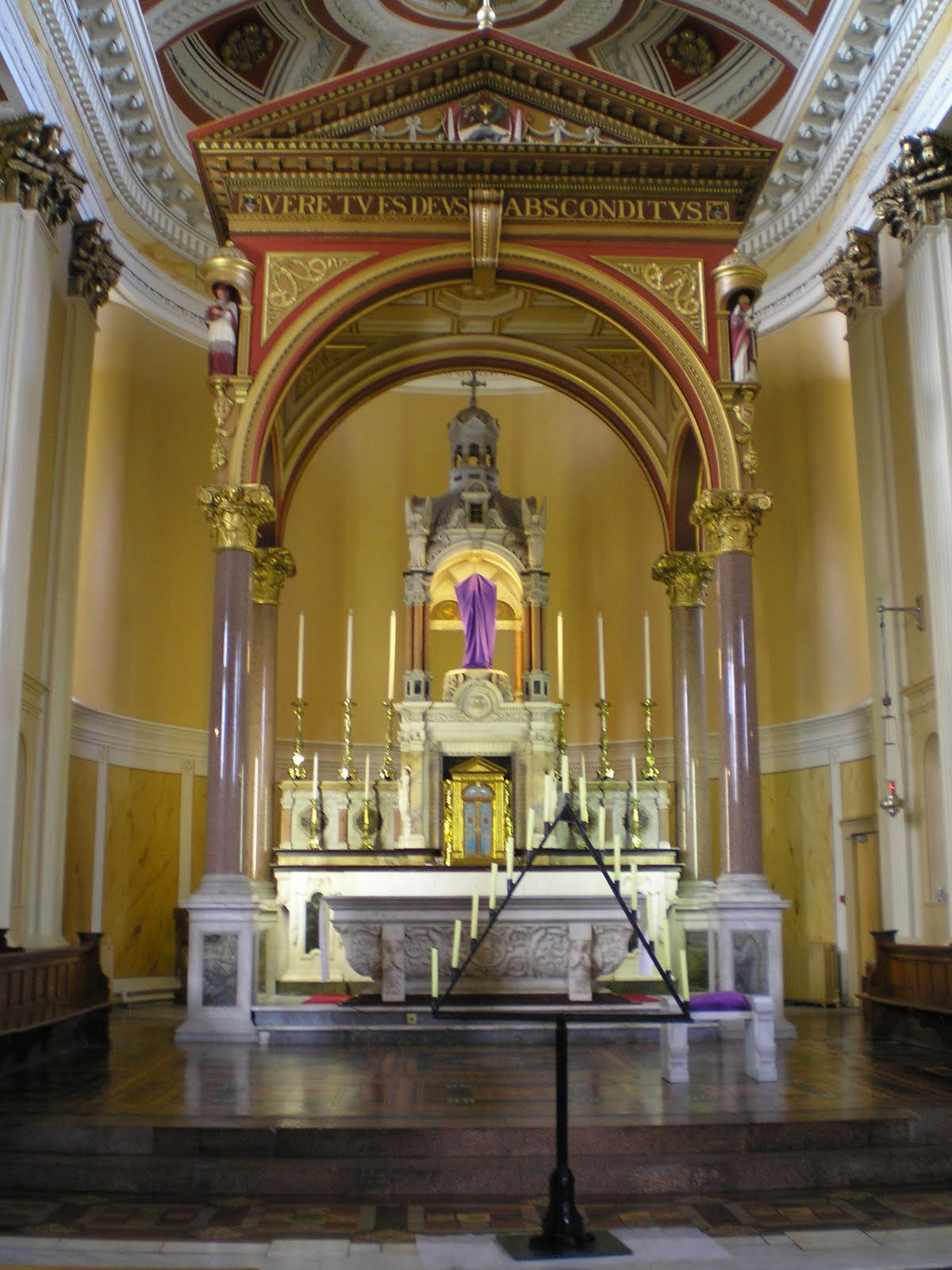
Side Altar of Blessed Thaddeus McCarthy
in Cobh Cathedral, County Cork
I. The Pilgrim of Ivrea was an Irish bishop who died in the year 1492. The most diligent search through our Irish annals will not discover another bishop to whom even so much of the poet's description will apply but Thaddeus McCarthy, Bishop of Cloyne. About that date there were indeed in Ireland five bishops named Thaddeus: 1. Thady, Bishop of Kilmore since before 1460, but his successor Furseus died in 1464 and Thomas, the third from him, died before 1492. 2. Thady McCragh of Killaloe succeeded in 1430 full sixty years before our saint's death at Ivrea. His third successor died in 1460. 3. Thady, Bishop of Down, was consecrated in Rome 1469, died in 1486 and his successor, R. Wolsey, was named before 1492. 4. Thady of Ross died soon after his appointment in 1488 succeeded by Odo in 1489. 5. Thady of Dromore, appointed only in 1511 and the see was held by George Brown in 1492. The date 1492 is alone enough to prove that B. Thaddeus of Ivrea was not any of the preceding bishops and there was no other of the name for full sixty years after or before but the Bishop of Cork and Cloyne the date of whose death fits exactly all the requirements of the case. Ware quotes from Harold that he was appointed by Innocent VIII (sed. 1484-1492), that he succeeded W. Roch resigned 1490, and further that Gerald who succeeded resigned in 1499, after obtaining a pardon from Henry VII in 1496 (Lib. Mun., i, p. 102).
II Another line of the old fragment seems to name the see of the B. Thaddeus whom the poet describes as lamenting his death abroad far from the "solum Chariense" or "Clovinense," which we interpret far "from Kerry," the burial place of his family, and "from Cloyne," his episcopal see. Cloyne is variously Latinized, even by Irish writers, Cloynensis, Clonensis, Cluanensis, and often Clovens or Clovinen in Rymer's Foedera.* What more natural than that a poet would describe the pilgrim as longing to be buried either in his cathedral church of Cloyne or with his fathers in Kerry.
III. The passage which seems to us most decisive is that which points to the royal extraction and name of this holy bishop "Regia progenies alto de sanguine Machar." Observe how, in the notice from Harold, Bishop McCarthy was called also 'Mechar.' Clearly both were one and the same name. Thus, Mac Carthaigh, anglicised McCarthy, is pronounced Maccaura, with the last syllable short as in Ard Magha (Armagh) and numberless like words. Hence Wadding,** in speaking of the foundation of Muckross Abbey, Killarney, by Domnal McCarthy, Prince of Desmond, quotes to this effect a Bull of Paul II in 1468 in which Domnall's name is spelled Machar, a form identical with that in the contemporary fragment. In truth there is no Irish family name like "Machar" at all but "Meagher" which is invariably spelled with "O," especially in the Latinized form and the O Meaghers had no claim to royal blood.
IV. The Blessed Thaddeus was "regia progenies." Now there was no royal family name in Ireland like that in the inscription except the truly royal name made more royal still by the saintly Bishop of Cloyne. Without insisting with Keating that the ancestry of the McCarthy family could be traced through twenty eight monarchs who governed the island before the Christian era, we may assert with the Abbé MacGeoghan, in a note (tom iii, p. 680), strangely omitted by his translator, "that if regard be had to primogeniture and seniority of descent the McCarthy family is first in Ireland." Long before the founders of the oldest royal families in Europe, before Rodolph acquired the empire of Germany, or a Bourbon ascended the throne of France, the saintly Cormac McCarthy the disciple the friend and patron of St. Malachy, ruled over Munster and the title of king was at least continued in name in his posterity down to the reign of Elizabeth. Few pedigrees if any, says Sir B. Burke, "in the British empire can be traced to a more remote or exalted source than that of the Celtic house of McCarthy... They command a prominent perhaps the most prominent place in European genealogy." Plain then is it that in no other house could the "regia progenies" be verified more fully than in the McCarthy family.***
V. The date of death, the wished for burial place his native soil (Kerry) or his diocese (Cloyne) the name and royal extraction, all point to the Bishop of Cloyne as the saint whose relics are still worshipped at Ivrea. If we add that 'Chiar' is the usual Irish form of Kerry, that Domnall's (the founder of Irralagh) father's name was THADDEUS, not improbably our Saint's uncle, the evidence seems to be overwhelming.
VI. We have said there is no account in Irish writers of even the Bishop of Cloyne, except the few lines in Ware. The continental annalists of the religious orders do however speak of one celebrated Thaddeus, without mentioning his surname or country. Elsius (quoting De Ilerera and Crusen, whose works are not within our reach) notices Thaddeus de Hipporegio sive Iporegia as "a man distinguished for learning, religious observance, preaching, holiness of life and experience, a man of great zeal and a sedulous promoter of the interests of his order." He was prior, he adds, of several convents, seven times definitor, thirteen times visitator, four times president of synods, nine times vicar general and his government was ever distinguished for the greatest love of order and edifying example. See Els Encom August p. 645. After quoting these words in substance from the Augustinian chronicler, Dr. Renehan adds: "After the most diligent inquiry I could make at Ivrea, wherever I could hope for any little information, particularly at the episcopal palace where I was received with marked respect as a priest from the country that sent out the B. Thaddeus, and of the Bishop's secretary, the vicar general and many others whose kind attention I can never forget, I could find no vestige of any other Thaddeus called after the city Eporedia but our own blessed Irish bishop and I was assured, over and over again, that he was the only Thaddeus known in its annals or who ever had any connection with the town by birth, residence, death or any way known to the present generation. It is not then unreasonable to suppose that the Thaddeus so celebrated in the Augustinian Order was no other than our Bishop. True, Elsius gives 1502 for the date of the friar's demise but Elsius is never to be trusted in dates and the printer may easily take MCCCCXCII, the true date, for MCCCCCII. Indeed 1492 is not so different from 1502 that an error may not have crept in.
Dr. Renehan's theory, then, with regard to B. Thaddeus, fully detailed in the letter to the Bishop of Ivrea was this:-
Thaddeus McCarthy was born in Kerry, where the McCarthy More branch of the family resided, and where, in the monastery of Irialac (now Muckross), or in Ennisfallen (see Archdall), the princes of the house were always buried. The young Thaddeus went abroad at an early age and embraced the monastic life. His virtues and piety soon attracted the notice of his religious brethren, as manifest from their chronicles. They became in time known to the ruling Pontiff Innocent VIII who raised him to the episcopal dignity. The B. Thaddeus repaired to Rome, in the first place to receive consecration and jurisdiction from the successor of St. Peter, imitating in this the example of our great patron saint. He stopped at Ivrea, probably on his way home, fell sick there and died, God witnessing to His servant by signs and wonders. The silence of our annalists is thus accounted for to a great extent by the long residence of B. Thaddeus abroad. This theory is remarkably borne out by the independent notice in last Record. Having little to help us to arrive at any correct notion of the saintly bishop's life beyond the epitaph and the slender tradition at Ivrea, we entirely subscribe to this view. Other sources of information may be opened now that we have ventured to bring for the first time the name of B. Thaddeus before the Irish Catholic people, and for this service, little as it is, and entirely unworthy of our saintly bishop, we still expect his blessing in full measure.
Footnotes
*Clove CIoyne fiymer's Foedera Tom v par iv p 105 Lib Mun Tom i par iv p 102
**"Maccarthy=Carthy=Macare=Maccar." Wadd. Annal. Min. ad. an. 1340 n. 25, ed. Roman, tom. viii, p. 241; ibid tom. xiii, p. 432, et pp. 558-9.
***"Kings of the McCarthy race," Annuls of Innisfallen, ad an. 1106, p. 106, an 1108, 1110, 1176. Annals of Boyle, an. 1138, 1185. Annals of Ulster, an. 1022-3, 1124. Gir. Cambr. lib. i, cap iii. S. Bernard in Vit. Malac., cap. iv. "Their burial place," Archdall Monast. Hib. pp. 302, 303.
Blessed Thaddeus McCarthy (IER)(1)
From the Irish Ecclesiastical Record, Volume 1 (1836), at pages 375 and following:
In an article of the Record for April page 312 we briefly referred to a Bishop of Cloyne and Cork who is venerated as blessed in Ivrea a town of Piedmont. In conformity with the few fragments preserved in the archives of Ivrea and elsewhere regarding him we adopted the opinion that his name according to modern orthography should be rendered Thaddeus Maher. Since the publication of the article just mentioned a paper containing much valuable matter has been communicated to us through the great kindness of the Very Rev. Dr. McCarthy, the learned Professor of Scripture in Maynooth College, who had prepared it long before the article in the Record was published and before he could have had any knowledge of our views on this subject. We are anxious to publish every document that we can find on this interesting question in the hope that by discussing it light may be thrown on the history of a holy Irish bishop who is honoured beyond the Alps but so little known at home that there is great difficulty in determining his real name. In one of our next numbers we shall return to this subject.
On June 23rd 1847 the Most Rev Dr Murray Archbishop of Dublin received at Maynooth a letter covering a bill of exchange for £40 (1,000 francs) sent for the relief of the famine stricken poor of Ireland by order of the good Bishop of Ivrea. The town of Ivrea anciently Eporedia is the capital of the Piedmontese province of the same name which extends from the Po to the Alps. The province contains a population of over one hundred thousand of whom about eight thousand reside in the town where is also the bishop's see. The letter to Dr. Murray enclosed a separate paper of which the following is a copy:-
Anno Domini millesimo quadringentesimo nonagesimo secundo, die vigesima quarta Octobris, Eporediae (antiquae urbis Transalpinae in Pedemontio) postremum obiit diem in hospitio peregrinorum sub titulo Sancti Antonii, quidam viator incognitos; atque eodem instante lux mira prope lectum in quo jacebat effulsit, et Episcopo Eporediensi apparuit homo venerandus, Pontifi calibus indumentis vestitus THADDEUM MACHAR Hiberniae Episcopum ilium esse innotirit ex chartis quas deferebat, et in Cathedrali ejus corpus solemni pompa depositum est snb altari, et in tumulo Sancti Eusebii Episcopi Epbrediensis, atque post paucos dies coepitmulta miracula facere.
Acta et documenta ex quibus ejus patria et character episcopalis tune innotuerunt, necnon ad patratorum miraculorum seu prodigiorum memoriam exarata, interierunt occasione incendii quo seculo xvii. Archivium Episcopate vastatum est. In qua darn charta pergamena caracteribus Gothicis scripta, quae in Archivio Ecclesiae Cathedralis servatur haec leguntur:
"Marmoreis tumulis hoc templo Virginis altuae Corpora Sanctorum plura sepulta jacent Martinus hic...
"Inde Thaddeus adest quern misit Hibernia praesul
Sospite quo venit saepe petita salus
Regia progenies alto de sanguine Machar,
Quern nostri in Genua nunc Latiique vocant.
Ingemuit moriens quem Hiberno sidere cretum
Non Cariense tenet, non Clovinense solum.
Sic visum superis; urbs Eporedia corpus
Templo majore marmoreo claudat opus.
Hicjacet Eusebii testudinis ipse sacello,
Pauperiem Christi divitis inde tulit.
Hunc clarum reddunt miracula sancta: beatus
Exstat et in toto dicitur orbe pius.
Huc quicunque venis divum venerare Thaddeum
Votaque fac precibus: dicque viator, Ave.
Mille quadringentos annos tune orbis agebat
Atque Nonagenos: postmodum junge duos."
Verbis illis solum Cariense vel Cloviense et Clovinense desi nari a poeta civitates Hibemiae in quibus Thaddeus aut natus aut Episcopus fuerit, putandum est forsan Clareh, Carrick.
Quamobrem exquiritur utrmm in Hibernia habeatur notitia hujus Episcopi THADDEI MACHAII - loci ubi natus fuerit, - ejus familiae quae regia seu princepssupponitur in poesi, - civitatis seu ecclesiae in qua fuerit Episcopus. Desiderantur quoque notitiae si quae repenri poterunt et documenta quibus illius vita et gesta illustrari possint; insuper utrum labente saeculo xv. an qua persecutio in Hibernia ad versus Episcopos facta sit, quemadmodum argumentari licet ex quibusdam Epistolis Innocentii VIII. circa immunitatem ecclesiasticam. (End of paper)
As our space precludes a literal translation of this paper a summary may be acceptable to the reader:
On the 24th of October 1492 died at Ivrea in St. Antony's Hospice for Pilgrims Blessed Thaddeus, an Irish bishop, whose body was deposited under the high altar of the cathedral in a shrine over the relics of the holy patron St. Eusebius. At the time of death a brilliant light was seen round his bed and at the same moment to the Bishop of Ivrea there appeared a man of venerable mien clothed in pontifical robes. Several other miracles were also wrought through his intercession. The papers found with him showed he was an Irish bishop and these as well as other documents proving his great sanctity religiously kept in the episcopal archives were destroyed by fire in the seventeenth century. In an old parchment written in Gothic letters still preserved in the archives of the cathedral church are these lines:
Neath marble tombs in this the virgjn's shrine
The bones of many a saint in peace recline
Here martyred Thaddeus there
From Erin's shore he came
A bishop of McCarthy's royal name
At whose behest were wondrous cures oft made
Still Latium Genoa invoke his aid
Dying he mourned that not on Irish soil
Where sped his youth should close his earthly toil
Nor Cloyne nor Kerry but Ivrea owns
For God so willed the saintly bishop's bones
'Tis meet that they in marble shrine encased
Should be within the great cathedral placed
Like Christ whose tomb was for another made
He in Eusebius cenotaph is laid
Soon sacred prodigies his power attest
And all the Earth proclaims him pious blest
O ye who hither come our saint assail
With prayers and votive gifts nor traveller fail
To greet with reverence the holy dead
Since Christ was born a thousand years had fled
Four hundred then and ninety two bacide
Had passed away when St. Thaddeus died.
When Dr Murray received the Bishop of Ivrea's letter he placed it in the hands of the late venerated President of Maynooth College from whose MSS it is now copied together with the very literal translation of the verses made by one of the junior students at the time Dr. Renehan undertook to collect all the notices of Blessed Thaddeus in our Irish annals and to give the best answers he could to the bishop's questions. He even visited Ivrea in the summer of 1850 in the hope of finding traditional records of the life of Blessed Thaddeus but to no purpose. He found the task more difficult than might be expected. All the knowledge regarding the saint's family, see, etc., that can be gathered from Irish or British sources is found in these few lines from Ware on the Bishops of Cloyne:
"THADY McCARTHY succ. 1490. Upon the resignation of William, Thady McCarthy, by some called Mechar, succeeded the same year by a provision from Pope Innocent VIII as may be seen from the Collectanea of Francis Harold" Ware's Bishops (Harris) p. 563
The Blessed Thaddeus's name is unhonoured then in his own country; his biography if ever written is at least not recorded by the Irish historians. Even the scanty information which the industrious Ware supplies was gleaned not from our annals but from Harold's Collectanea probably notes and extracts taken from documents in the continental libraries. Dr. Renehan had therefore little to add on our saint's life. He was however fully satisfied that Blessed Thaddeus of Ivrea was no other than the Bishop of Cork and Cloyne mentioned by Ware. His arguments may be seen in a rough outline of his answer to the Bishop of Ivrea's letter among the O'Renehan MSS in Maynooth, almost the only authority we had time to consult for this notice. Sometimes the very words of the letter are given in inverted commas:-
The Reliquary of Blessed Thaddeus McCarthy
In the North Cathedral, Cork City
BLESSED THADDEUS McCARTHY
In an article of the Record for April page 312 we briefly referred to a Bishop of Cloyne and Cork who is venerated as blessed in Ivrea a town of Piedmont. In conformity with the few fragments preserved in the archives of Ivrea and elsewhere regarding him we adopted the opinion that his name according to modern orthography should be rendered Thaddeus Maher. Since the publication of the article just mentioned a paper containing much valuable matter has been communicated to us through the great kindness of the Very Rev. Dr. McCarthy, the learned Professor of Scripture in Maynooth College, who had prepared it long before the article in the Record was published and before he could have had any knowledge of our views on this subject. We are anxious to publish every document that we can find on this interesting question in the hope that by discussing it light may be thrown on the history of a holy Irish bishop who is honoured beyond the Alps but so little known at home that there is great difficulty in determining his real name. In one of our next numbers we shall return to this subject.
On June 23rd 1847 the Most Rev Dr Murray Archbishop of Dublin received at Maynooth a letter covering a bill of exchange for £40 (1,000 francs) sent for the relief of the famine stricken poor of Ireland by order of the good Bishop of Ivrea. The town of Ivrea anciently Eporedia is the capital of the Piedmontese province of the same name which extends from the Po to the Alps. The province contains a population of over one hundred thousand of whom about eight thousand reside in the town where is also the bishop's see. The letter to Dr. Murray enclosed a separate paper of which the following is a copy:-
De Beato Thaddeo Episcopo Hiberniae
Anno Domini millesimo quadringentesimo nonagesimo secundo, die vigesima quarta Octobris, Eporediae (antiquae urbis Transalpinae in Pedemontio) postremum obiit diem in hospitio peregrinorum sub titulo Sancti Antonii, quidam viator incognitos; atque eodem instante lux mira prope lectum in quo jacebat effulsit, et Episcopo Eporediensi apparuit homo venerandus, Pontifi calibus indumentis vestitus THADDEUM MACHAR Hiberniae Episcopum ilium esse innotirit ex chartis quas deferebat, et in Cathedrali ejus corpus solemni pompa depositum est snb altari, et in tumulo Sancti Eusebii Episcopi Epbrediensis, atque post paucos dies coepitmulta miracula facere.
Acta et documenta ex quibus ejus patria et character episcopalis tune innotuerunt, necnon ad patratorum miraculorum seu prodigiorum memoriam exarata, interierunt occasione incendii quo seculo xvii. Archivium Episcopate vastatum est. In qua darn charta pergamena caracteribus Gothicis scripta, quae in Archivio Ecclesiae Cathedralis servatur haec leguntur:
"Marmoreis tumulis hoc templo Virginis altuae Corpora Sanctorum plura sepulta jacent Martinus hic...
"Inde Thaddeus adest quern misit Hibernia praesul
Sospite quo venit saepe petita salus
Regia progenies alto de sanguine Machar,
Quern nostri in Genua nunc Latiique vocant.
Ingemuit moriens quem Hiberno sidere cretum
Non Cariense tenet, non Clovinense solum.
Sic visum superis; urbs Eporedia corpus
Templo majore marmoreo claudat opus.
Hicjacet Eusebii testudinis ipse sacello,
Pauperiem Christi divitis inde tulit.
Hunc clarum reddunt miracula sancta: beatus
Exstat et in toto dicitur orbe pius.
Huc quicunque venis divum venerare Thaddeum
Votaque fac precibus: dicque viator, Ave.
Mille quadringentos annos tune orbis agebat
Atque Nonagenos: postmodum junge duos."
Verbis illis solum Cariense vel Cloviense et Clovinense desi nari a poeta civitates Hibemiae in quibus Thaddeus aut natus aut Episcopus fuerit, putandum est forsan Clareh, Carrick.
Quamobrem exquiritur utrmm in Hibernia habeatur notitia hujus Episcopi THADDEI MACHAII - loci ubi natus fuerit, - ejus familiae quae regia seu princepssupponitur in poesi, - civitatis seu ecclesiae in qua fuerit Episcopus. Desiderantur quoque notitiae si quae repenri poterunt et documenta quibus illius vita et gesta illustrari possint; insuper utrum labente saeculo xv. an qua persecutio in Hibernia ad versus Episcopos facta sit, quemadmodum argumentari licet ex quibusdam Epistolis Innocentii VIII. circa immunitatem ecclesiasticam. (End of paper)
As our space precludes a literal translation of this paper a summary may be acceptable to the reader:
On the 24th of October 1492 died at Ivrea in St. Antony's Hospice for Pilgrims Blessed Thaddeus, an Irish bishop, whose body was deposited under the high altar of the cathedral in a shrine over the relics of the holy patron St. Eusebius. At the time of death a brilliant light was seen round his bed and at the same moment to the Bishop of Ivrea there appeared a man of venerable mien clothed in pontifical robes. Several other miracles were also wrought through his intercession. The papers found with him showed he was an Irish bishop and these as well as other documents proving his great sanctity religiously kept in the episcopal archives were destroyed by fire in the seventeenth century. In an old parchment written in Gothic letters still preserved in the archives of the cathedral church are these lines:
Neath marble tombs in this the virgjn's shrine
The bones of many a saint in peace recline
Here martyred Thaddeus there
From Erin's shore he came
A bishop of McCarthy's royal name
At whose behest were wondrous cures oft made
Still Latium Genoa invoke his aid
Dying he mourned that not on Irish soil
Where sped his youth should close his earthly toil
Nor Cloyne nor Kerry but Ivrea owns
For God so willed the saintly bishop's bones
'Tis meet that they in marble shrine encased
Should be within the great cathedral placed
Like Christ whose tomb was for another made
He in Eusebius cenotaph is laid
Soon sacred prodigies his power attest
And all the Earth proclaims him pious blest
O ye who hither come our saint assail
With prayers and votive gifts nor traveller fail
To greet with reverence the holy dead
Since Christ was born a thousand years had fled
Four hundred then and ninety two bacide
Had passed away when St. Thaddeus died.
When Dr Murray received the Bishop of Ivrea's letter he placed it in the hands of the late venerated President of Maynooth College from whose MSS it is now copied together with the very literal translation of the verses made by one of the junior students at the time Dr. Renehan undertook to collect all the notices of Blessed Thaddeus in our Irish annals and to give the best answers he could to the bishop's questions. He even visited Ivrea in the summer of 1850 in the hope of finding traditional records of the life of Blessed Thaddeus but to no purpose. He found the task more difficult than might be expected. All the knowledge regarding the saint's family, see, etc., that can be gathered from Irish or British sources is found in these few lines from Ware on the Bishops of Cloyne:
"THADY McCARTHY succ. 1490. Upon the resignation of William, Thady McCarthy, by some called Mechar, succeeded the same year by a provision from Pope Innocent VIII as may be seen from the Collectanea of Francis Harold" Ware's Bishops (Harris) p. 563
The Blessed Thaddeus's name is unhonoured then in his own country; his biography if ever written is at least not recorded by the Irish historians. Even the scanty information which the industrious Ware supplies was gleaned not from our annals but from Harold's Collectanea probably notes and extracts taken from documents in the continental libraries. Dr. Renehan had therefore little to add on our saint's life. He was however fully satisfied that Blessed Thaddeus of Ivrea was no other than the Bishop of Cork and Cloyne mentioned by Ware. His arguments may be seen in a rough outline of his answer to the Bishop of Ivrea's letter among the O'Renehan MSS in Maynooth, almost the only authority we had time to consult for this notice. Sometimes the very words of the letter are given in inverted commas:-
Tuesday, 3 July 2018
Latin Mass in Ballyhea - Feast of Our Lady of Mount Carmel
The next Traditional Latin Mass in St. Mary's Church, Ballyhea, Co. Cork, will be on the Feast of Our Lady of Mount Carmel, 16th July, at 12 noon.
Come and pray with us!
Location:
Ballyhea, Co. Cork, Ireland
Tuesday, 19 June 2018
Latin Mass in Ballyhea - Feast of Saints Peter and Paul
The next Mass in St. Mary's Church, Ballyhea, Co. Cork, will be on the Feast of Saints Peter and Paul, 29th June, at 12 noon.
Come and pray with us!
Location:
Ballyhea, Co. Cork, Ireland
Thursday, 29 March 2018
Traditional Easter Ceremonies
The Easter Ceremonies in the Gregorian Rite:
Holy Thursday
4 p.m. - Holy Mass: Silverstream Priory, Stamullen, Co. Meath
6 p.m. - Holy Mass: Sacred Heart Church, The Crescent, Limerick City
6 p.m. - Holy Mass: Ss. Peter and Paul's Church, Paul Street, Cork City
7 p.m. - Holy Mass: St. Kevin's Church, Harrington Street, Dublin 8.
7.30 p.m. - Tenebrae: Silverstream Priory, Stamullen, Co. Meath
Good Friday
12 noon - Stations of the Cross: Ss. Peter and Paul's Church, Paul Street, Cork City
3 p.m. - Liturgy of the Passion: Sacred Heart Church, The Crescent, Limerick City
3 p.m. - Liturgy of the Passion: Silverstream Priory, Stamullen, Co. Meath
5 p.m. - Liturgy of the Passion: St. Kevin's Church, Harrington Street, Dublin 8.
6 p.m. - Liturgy of the Passion: Ss. Peter and Paul's Church, Paul Street, Cork City
7 p.m. - Stations of the Cross: St. Kevin's Church, Harrington Street, Dublin 8.
7.30 p.m. - Tenebrae: Silverstream Priory, Stamullen, Co. Meath
Holy Saturday
12.30 p.m. - Tenebrae: Ss. Peter and Paul's Church, Paul Street, Cork City
8 p.m. - Easter Vigil: Silverstream Priory, Stamullen, Co. Meath
8.30 p.m. - Easter Vigil: Ss. Peter and Paul's Church, Paul Street, Cork City
9 p.m. - Easter Vigil: Sacred Heart Church, The Crescent, Limerick City
9 p.m. - Easter Vigil: St. Kevin's Church, Harrington Street, Dublin 8.
Easter Sunday
9 a.m. - Holy Mass: St. Mary's Church, Ballyhea, Co. Cork
9 a.m. - Holy Mass: St. Mary's Church, Chapel Street, Newry, Co. Down
10 a.m. - Holy Mass: St. Patrick's Church, Drumkeen, Co. Donegal
10 a.m. - Holy Mass: Silverstream Priory, Stamullen, Co. Meath
10.30 a.m. - Holy Mass: Sacred Heart Church, The Crescent, Limerick City
10.30 a.m. - Holy Mass: St. Kevin's Church, Harrington Street, Dublin 8.
12 noon - Holy Mass: Ss. Peter and Paul's Church, Paul Street, Cork City
1.30 p.m. - Holy Mass: Holy Cross Church (O.P.), Tralee, Co. Kerry
2 p.m. - Holy Mass: St. Columba's Church, Longtower, Derry City
4 p.m. - Holy Mass: St. Therese's Church, Somerton Road, Belfast City
5 p.m. - Holy Mass: St. Patrick's Church, College Road, Kilkenny City
5.30 p.m. - Holy Mass: Blessed Sacrament Chapel, Our Lady's Shrine, Knock, Co. Mayo
Beannachtaí na Cásca oraibh go léir!
A happy and holy Easter to one and all!
Tuesday, 13 June 2017
St. Carthage and Spike Island
The River Lee flows from Gougane Barra through the City of Cork, as a sort of perpetual re-enactment of the religious lift of the great Saint Finbar, whose monastery in Gougane was followed by his monastery and great school in Cork, where he spent the last seventeen years of his earthly life, until his holy death on 25th September, 623.
However, the Lee flows on past Cork into the ocean, just as Finbar's soul flowed on into eternal life - there is deep meaning in the flowing of rivers! As the Lee passes into its estuary, the harbour of Cork, it passes Spike Island, where Little Nellie of Holy God lived and where her mother died. Nellie had been born in Waterford, and it was another saint associated with Waterford who first sanctified Spike Island.
St. Carthage was born of a noble family of Kerry. He founded a monastery at Rahan in Offaly but was forcibly expelled with all his monks on account of the jealousy of local clerics about the year 634. Travelling south, he obtained a cure for the King of Munster, Cathal Mac Aodh, and was granted the islands in Cork harbour for a monastery. He seems to have resided there only a year but to have left a small monastic community there, including the three sons of Nascann, Bishop Goban, Sraphan the Priest and Saint Laserian. He then proceeded to Lismore, where he established his great monastery and school that was to form the basis of the present Diocese.
For this reason, even at the time of the Synod of Rathbreasail in 1110, it appears that the Diocese of Lismore extended as far as the Diocese of Cork and encompassed the Diocese of Cloyne. I cannot account for the 'disappearance' of the Diocese of St. Colman Mac Léine (522-604) for the period of four and a half centuries. There is also some doubt as to whether Spike Island itself was included in the Diocese of Lismore or of Cork at the time. Certainly, a decretal of Innocent III of 1199 includes Spike Island in the Diocese of Cork. There was certainly a Bishop in Cloyne by 1148 and the Diocese is listed among the Dioceses of Ireland at the Synod of Kells in 1152. Even as late as the 16th Century, the collection records include Kilworth in the Diocese of Lismore.
Returning to the Holy Island of Spike, the Martyrology of Tallaght recordes a St. Ruisen or Lappan in connection with Spike Island. He seems to be one with the Bishop of Cork, second successor of St. Finbar, who died in 685 or 687. The monastery was still extant in 821, when the death of Sealbhach, the abbot, is recorded.
The church and island of "Ynespic" was granted by Henry II to Milo de Cogan in 1177 and later fell to St. Thomas' Abbey in Dublin and at the time of the despoilation of the Religious Houses of Ireland in 1541, it was under the control of St. Catherine's, the Augustinian House in Waterford.
However, the Lee flows on past Cork into the ocean, just as Finbar's soul flowed on into eternal life - there is deep meaning in the flowing of rivers! As the Lee passes into its estuary, the harbour of Cork, it passes Spike Island, where Little Nellie of Holy God lived and where her mother died. Nellie had been born in Waterford, and it was another saint associated with Waterford who first sanctified Spike Island.
St. Carthage was born of a noble family of Kerry. He founded a monastery at Rahan in Offaly but was forcibly expelled with all his monks on account of the jealousy of local clerics about the year 634. Travelling south, he obtained a cure for the King of Munster, Cathal Mac Aodh, and was granted the islands in Cork harbour for a monastery. He seems to have resided there only a year but to have left a small monastic community there, including the three sons of Nascann, Bishop Goban, Sraphan the Priest and Saint Laserian. He then proceeded to Lismore, where he established his great monastery and school that was to form the basis of the present Diocese.
For this reason, even at the time of the Synod of Rathbreasail in 1110, it appears that the Diocese of Lismore extended as far as the Diocese of Cork and encompassed the Diocese of Cloyne. I cannot account for the 'disappearance' of the Diocese of St. Colman Mac Léine (522-604) for the period of four and a half centuries. There is also some doubt as to whether Spike Island itself was included in the Diocese of Lismore or of Cork at the time. Certainly, a decretal of Innocent III of 1199 includes Spike Island in the Diocese of Cork. There was certainly a Bishop in Cloyne by 1148 and the Diocese is listed among the Dioceses of Ireland at the Synod of Kells in 1152. Even as late as the 16th Century, the collection records include Kilworth in the Diocese of Lismore.
Returning to the Holy Island of Spike, the Martyrology of Tallaght recordes a St. Ruisen or Lappan in connection with Spike Island. He seems to be one with the Bishop of Cork, second successor of St. Finbar, who died in 685 or 687. The monastery was still extant in 821, when the death of Sealbhach, the abbot, is recorded.
The church and island of "Ynespic" was granted by Henry II to Milo de Cogan in 1177 and later fell to St. Thomas' Abbey in Dublin and at the time of the despoilation of the Religious Houses of Ireland in 1541, it was under the control of St. Catherine's, the Augustinian House in Waterford.
Thursday, 11 May 2017
Cork - The Rebel City
We are familiar with the title of Cork as "the Rebel County" and we don't need to doubt that there are plenty of historical episodes that could have gained that title for Cork. Here is my suggestion.
The scene is Cork City. The moment is April, 1603, the accession of James, King of Scots, to the throne of Elizabeth Tudor. The Desmond Rebellions had been crushed by 1583 and three years later the Plantation of Munster with loyal English Protestants had begun. The Nine Years' War (1584-1603) had see the defeat of the Gaelic Princes, including Donal O'Sullivan Beare of the Beara Penninsula. Cork had been the site of some of the most significant engagements, the Battle of Kinsale (1601) and the Seige of Dunboy (1602), not to forget the martyrdom of Blessed Dominic Collins in Youghal (1602), but Cork City, it seems, was not yet ready to give up the struggle for the liberty of the Catholic Faith.
About the year 1586, William Camden in his Britannia had described Cork for Queen Elizabeth I as: "a populous little trading town, and much resorted to; but so beset with rebel enemies on all sides, that they are obliged to keep constant watch, as if the town were continually besieged ; and they dare not marry out their daughters in the country, but contract one with another among themselves, whereby all the citizens are related in one degree or other."
Speaking of the rebelliousness of Cork City towards the English Crown only a generation later, the historian Charles Gibson writes in his The History of the County and City of Cork, London & Cork, 1861, that: "...there were two other serious causes of discontent; and it would be difficult to say to which the people were most opposed; the one was an attempt of the government to force base money into circulation, and the other to press the Protestant religion upon a people who thoroughly detested it, and held it as corrupt as the coinage."
It is topical, in light of the present difficulties of the €uro to recall the words of Lord Deputy Mountjoy: "And first, whereas, the alteration of the coyne and taking away the exchange in such a measure as that first promised, hath bred a general grievance to men of all qualities, and so many incommodities to all sorts, that it is beyond the judgment of any I can see, or hear, to prevent confusion in the estate, by the continuance thereof... They not only pay excessive prices for all things, but can hardly get anything for their money."
Mountjoy was retained as representative of the English Crown in Ireland when Elizabeth died and was succeeded by James I. He sent emissaries to the Mayor of Cork to have James proclaimed King in Cork. The Mayor replied that the Charter allowed him to take time to consider it.
Gibson continues the account:
"Sir George Thornton, one of the two commissioners of Munster, applied to Thomas Sarsfield, then mayor, who replied that the charter allowed his taking "time to consider of it." Sir George replied that the king, who had a just right to the crown, had been proclaimed in Dublin, and that a delay would be taken ill. The mayor replied smartly enough, that Perkin Warbeck had also been proclaimed in Dublin; and that much damage had come of their precipitation.
"The Chief Justice of Munster, Saxey, who was present, said they should be committed, if they refused. Wm. Mead, the recorder, replied, " There was no one there had authority to commit them." The mayor, and corporation, adjourn to the court-house. Sir George Thornton paces up and down the walk outside, and after a time sends in to know if they have come to a decision. "No." He waits another hour, and is informed by the recorder, in a passionate manner, that they can give him no answer till the next day. Sir Richard Boyle, afterwards Earl of Cork, who was at this time Clerk of the Presidential Council of Munster, requested Mead not to "break out in so unreasonable and choleric a fashion." Mead, who was as smart as the mayor at reply, said, "Though I do not break out, there are several thousands ready to do so." Sir George Thornton requires an account of these words. "Very well," says Mead, "but the city must have three or four days to consult about this ceremony."
"The recorder, who appears to have been the ring-leader of the rebellion, employed the time in arming the citizens, and guarding the gates against the admission of his majesty's troops; but "they admitted several Irish, to whom they gave arms." An attempt was also made to seize Haulbowline, which had been but recently fortified. " About this this time," January, 1602 writes Stafford, "the Lord Deputie and the Lord President went by boate to an island in the river of Corke, called Halbolin, sixe or seven miles from the citie, which upon view they thought fit to be fortified, being so seated as that no shipping of any burden can pass the same, but under the command thereof. Whereupon direction was given to Paul Ive, an ingeneere, to raise a fortification there." Pacata Ililernia, pp. 451, 452.
"Boyle gives us the most circumstantial account of this foolish rebellion, which seems to have sprung up without premeditation, and to have proceeded without plan, or any particular object on the part of the leaders. Sir George Thornton desires the citizens to send, or rather allow some cannon to go from Cork to the relief of Haulbowline. They reply, "We have, as you see, called our brethren together about this business, and we have come to the resolution, that the fort of Haulbowline is a very pestilent impoverishment to our corporation, and therefore think it not meet to suffer any relief to go thither, nor will we." Are we to conclude from this language, that the corporation were at the expense of finding and maintaining this fort? They say again, "This fort was a needless work, and built in their franchises, without their consent, by the Lord President, [Carew] but not for any good to the city." They add, that they will "take the fort, and keep possession of it."
"Richard Boyle mentions one "Edward Roche, the brother of Dominick Roche, the priest," and Owen Mac Redmond, a schoolmaster, as taking an active part in this rebellion. " This fellow," continues Sir Richard, speaking of the schoolmaster, " said it was not known who was King of England. That, to his own knowledge, about seven or eight years ago, there was no other mockery in all the stage plays, but the King of Scots ; that no Englishman would abide the government of a Scot; that he was the poorest prince in Europe; that the President of Munster kept a better table than he."
"Stephen Brown," continues Boyle, "was a great director about the ordnance, as also one Thomas Fagan, who fired a shot at Mr. James Grant, when he was returning to Sir Charles Wilmot, who sent him to the mayor. He had before this stripped Mr. Grant of his clothes, was the first man who put on his head-piece, and seized on the king's stores in the city. He said, for his part, no king should rule him, but such as would give him liberty of conscience. He carried a white rod about the city, and was styled their principal church-warden, and never suffered an Englishman or Protestant to pass by him unabused. He had the impudence to revile Sir Gerald Herbert, because he would not put off his hat, and do reverence to the cross, which he was then carrying about in procession.
"Sir Robert Mead, or Meagh, and John Fitz-David Roche, were two priests who fomented this rebellion. Mead ordered Mr. Apsley, the king's storekeeper, to be killed, and his arms taken away. He also ordered the guard, which he placed on Skiddy's Castle, where the stores lay, to throw Mrs. Hughes, wife to the clerk of stores, over the walls and break her neck. He was the principal stirrer-up of the townsmen to take arms, and not only assisted in every sally to take and destroy the forts, but also drove such as were dilatory with a cudgel to the work.
"John Nicholas, a brewer, was also a cannonier to the rebels, and it was proved against him that he shot two soldiers from the walls; he was assisted by John Clarke, a tanner, from Mallow, who very dexterously mounted the cannons upon the walls, when none else knew how to do it. He and Nicholas were both Englishmen. It was proved against Edmund Terry, another rebel, that he advised the mayor to take the key of Skiddy's Castle from Mr. Hughes, the store-keeper, and place the ammunition in Dominick Galway's cellars, and that Hughes should not be suffered to come there without a sufficient guard; all which the mayor complied with. Edward Roche, brother to Dominick Roche, said that the city would fight against the king himself if he came to look for it, and that not only the country, but also the kings of France and Spain would assist them, if he did not give their church free liberty," Sir Richard Boyle continues, " The mayor and recorder imprisoned Mr. Allen Apsley, commissary of the king's victuals, and Mr. Michael Hughes, clerk of the munitions. The recorder, in person, with a guard, carried Mr. Apsley from his own house to the common gaol, and then distributed the king's stores as he thought proper. They demolished the fort on the south side of the city, in which action they killed and wounded several soldiers. The day before they demolished this fort, the recorder, striking himself on the breast, solemnly swore, at the door of Skiddy's Castle, that if the mayor would not take charge of the king's stores he would presently quit the town for ever, upon which he turned about to the crowd, who huzzaed and applauded him for his speech; then Thomas Fagan and Murrough clapped on their head-pieces, and with their swords and targets forcibly possessed themselves of Skiddy's Castle.
"The day before they demolished the fort, the mayor assembled the citizens, and told them, that before forty hours passed, all Ireland would be in arms against the king ; that the crown of England should never more recover Ireland. He also wrote several seditious letters to most of the lords and chief men of this province, desiring them to join the citizens in their cause, which was for liberty of conscience.
"The recorder being asked why the king's fort was broken down by the people answered, it was his act, and that he would justify it ; and said it was the act of the whole corporation, and done advisedly, and that they would make it good, saying, "That the building of that fort cost the queen nothing, it being raised by the citizens," adding, "that the worst that could be done,
was to make them rebuild it.
"Several of them publicly abused the commissioners and the king's officers in this province, calling them 'traitors,' destroyers of the city and commonwealth,' ' base-born fellows,' 'beggarly companions,' 'yeomen's sons,' all of which was proved on their respective trials. Lieutenant Murrough had the impudence to send Sir Charles Wilmot word, that he was a traitor, and would prove it. His brother had been aide-de-camp to Captain Flower at the siege of Kinsale; but he quitted his colours and deserted to the Spaniards, for which he was afterwards executed.
"It only remained for the commissioners to proclaim James the Sixth of Scotland and First of England, outside the walls, as they were not allowed to do so inside.
"Sir George Thornton, accompanied by Lord Roche and supported by eight hundred soldiers, proclaimed the king in the north suburbs, near Shandon Castle, the recorder protesting all the while against such a violation of their "liberties." The commissioners, who appeared to have acted with great moderation, sent to Haulbowline for artillery, when the citizens, under the leadership of William Terry, attempted to intercept them. A scuffle ensued, and several were killed on both sides.
"The religious element in this rebellion was paramount. Though a large portion of the inhabitants of Cork were of Danish, Norman, and Saxon descent, they were sincere Catholics, who hoped for the reestablishment of their own faith at the death of the queen. They had not forgotten, though five-and-twenty years had elapsed, that the Protestant bishop had burned the image of St. Dominick at the High Cross of Cork. They now retaliate, by retaking possession of the churches which they sprinkle in order to exorcise the demon of Protestantism by burning Protestant bibles and prayer-books; by razing out the ten commandments, and substituting the emblems of their own faith. A number took the sacrament to strengthen them in defence of their religion. A legate from the Pope went through the city in procession with a cross, compelling all he met to bow down to it. They not only fired on Shandon Castle, where Lady Carew lodged, but on the bishop's palace, where the commissioners were assembled; they killed Mr. Rutledge, and wounded a servant of Bishop Lyon, and told him, if they had his traitor-master, he should not escape with his life. Such language and conduct is indicative of the detestation in which the Protestant religion was held even in the towns where it had been nurtured for half a century.
"But this state of things could not be long countenanced in a city like Cork; and the mayor and sheriffs knowing the decided character of the Lord Deputy Mountjoy, wrote him saying, they had received the king's proclamation on the 11th of April, but had put off the ceremony till the 16th, that it might be done with more solemnity. They also requested that the fort of Haulbowline might be put into their hands, and complained that soldiers in that fort had shot at some fishermen and boats which had been sent out for provisions. The commissioners, of course, gave his lordship a very different version of the transaction.
"Mountjoy wrote them "a smart letter" in reply, reproving them for "setting up the mass," by their own authority, their insolence in stopping his majesty's stores and artillery from being sent to Haulbowline, and attempting to get them into their hands. At the same time, his lordship wrote to Sir Charles Wilmot and Sir George Thornton, ordering them to send as much victuals and provisions as they could, out of the city, to that fort, and Shandon Castle; to draw some companies into the town; and informed them, that he had assembled five thousand men to correct their insolences; and that as most of the other towns in the province had committed the like disturbances, he intended to begin with Waterford, who led the example to the rest.
"The following is Dr. Ryland's account of the Lord Lieutenant's visit to Waterford : "The Lord Deputy Mountjoy, judging that the situation of affairs of the province, required his immediate personal attention, proceeded with a numerous army into Munster, and on the 5th of May, 1603, came to Grace-Dieu, within the liberties of Waterford, and summoned the mayor to open the gates, and receive him and his army into the city. The spirit of rebellion immediately appeared ; the gates were shut against him, and the citizens pleaded that, by a charter of King John, they were exempted from quartering soldiers. While the parties were thus engaged, two ecclesiastics, Dr. White and a young Dominican friar, came into the camp ; they were habited in the dresses of their order, Dr. White wearing a black gown and cornered cap, and the friar wearing a white woollen frock. When they entered the Lord Deputy's tent, Dr. White commenced a violent religious controversy, 'all of which,' we are told, his lordship did most learnedly confute.' He then severely reprehended the conduct of the citizens; threatened to draw King James sword, and cut the charter of King John to pieces ; and declared his intention, if they persisted in their obstinacy, to level their city, and strew it with salt. His menaces were effectual; the citizens immediately submitted, and received the Lord Deputy and his army within their walls. They afterwards took the oath of allegiance, renounced all foreign jurisdiction, and, to prevent any future disturbance, a garrison was stationed in the city.
"Mountjoy wrote to the Mayor of Cork, from his camp at Grace-Dion, near Waterford, requesting him "to desist from his practices," saying, if he persevered, he must adopt more severe measures than he willingly would ; but many of the citizens, undeterred by this mild threat, were opposed to his admission. Mead, the recorder, strongly opposed it, so did Gould, Fagan, Captain Terry, Lieutenant Murrough, and "an infinite number of mob;" but Alderman Coppinger, John Coppinger, Alderman Terry, the Galways, the Vernons, and the Martels, insisted that the viceroy should be received within the walls.
"He entered Cork on the 11th of May, 1603. The citizens laid plough-shares on each side of the street through which he passed, intimating that the destruction of the growing crops, by the soldiers, had caused so many ploughs to lie idle. As in the fable of the belly and the members, the citizens were at length brought to understand, that their interests were identified with the country. To see the city of Cork, which had been always armed cap-a-pie, against the country, admitting the Irish within its walls, and laying their idle plough-shares before the eyes of the viceroy, was something new in the history of these times. Smith says " the Lord Lieutenant took little notice of this silly contrivance." We did not expect to find Doctor Smith making so silly a remark. A people's cry for bread should sound in a ruler's ears as the roar of a famished lion. But the Lord Lieutenant did notice it; his letter to the English council, from which we have quoted, contains the prediction of a dearth, which would "breed new combinations, and would stirre the townes themselves; " and his mild chastisement of the present rebellion, is something like an admission that the people had great cause for dissatisfaction. Murrough, Butler, and the schoolmaster, Owen Mac Redmond, who had no freeholds, were the only parties executed by martial law. Mead, the recorder, who was the ringleader, was tried by an Irish jury, and acquitted. The grand jury found true bills against Mead, Richard Gould, and others. Gould pleaded, in justification, before Sir Charles Wilmot, and Sir George Thornton, commissioners, Sir Nicholas Walsh, William Saxey, and George Comerford, justices, the injury he had sustained by being compelled to take the mixed or base money. He proved that the late Lord President's steward had purchased twenty barrels of wheat for the Lady Carew, which he, Richard Gould, had purchased in France for nineteen shillings a barrel, of good silver money, and that the steward would give him but twenty shillings of the new standard or mixed money. The Cork jury, by whom he was tried and acquitted for the attack on Haulbowline, must have held that such fraudulent conduct was enough to drive any honest trader into rebellion. Mead, the recorder, appears to have had deeper projects in view. He afterwards got a pension from Spain, and went to Naples, where he wrote a treasonable tract, called, "Advice to the Catholics of Munster" a copy of which is preserved in the Bodleian Library at Oxford. He died in Naples."
[First Published on the St. Conleth's Catholic Heritage Blog in May, 2010]
The scene is Cork City. The moment is April, 1603, the accession of James, King of Scots, to the throne of Elizabeth Tudor. The Desmond Rebellions had been crushed by 1583 and three years later the Plantation of Munster with loyal English Protestants had begun. The Nine Years' War (1584-1603) had see the defeat of the Gaelic Princes, including Donal O'Sullivan Beare of the Beara Penninsula. Cork had been the site of some of the most significant engagements, the Battle of Kinsale (1601) and the Seige of Dunboy (1602), not to forget the martyrdom of Blessed Dominic Collins in Youghal (1602), but Cork City, it seems, was not yet ready to give up the struggle for the liberty of the Catholic Faith.
About the year 1586, William Camden in his Britannia had described Cork for Queen Elizabeth I as: "a populous little trading town, and much resorted to; but so beset with rebel enemies on all sides, that they are obliged to keep constant watch, as if the town were continually besieged ; and they dare not marry out their daughters in the country, but contract one with another among themselves, whereby all the citizens are related in one degree or other."Speaking of the rebelliousness of Cork City towards the English Crown only a generation later, the historian Charles Gibson writes in his The History of the County and City of Cork, London & Cork, 1861, that: "...there were two other serious causes of discontent; and it would be difficult to say to which the people were most opposed; the one was an attempt of the government to force base money into circulation, and the other to press the Protestant religion upon a people who thoroughly detested it, and held it as corrupt as the coinage."
It is topical, in light of the present difficulties of the €uro to recall the words of Lord Deputy Mountjoy: "And first, whereas, the alteration of the coyne and taking away the exchange in such a measure as that first promised, hath bred a general grievance to men of all qualities, and so many incommodities to all sorts, that it is beyond the judgment of any I can see, or hear, to prevent confusion in the estate, by the continuance thereof... They not only pay excessive prices for all things, but can hardly get anything for their money."Mountjoy was retained as representative of the English Crown in Ireland when Elizabeth died and was succeeded by James I. He sent emissaries to the Mayor of Cork to have James proclaimed King in Cork. The Mayor replied that the Charter allowed him to take time to consider it.
Gibson continues the account:
"Sir George Thornton, one of the two commissioners of Munster, applied to Thomas Sarsfield, then mayor, who replied that the charter allowed his taking "time to consider of it." Sir George replied that the king, who had a just right to the crown, had been proclaimed in Dublin, and that a delay would be taken ill. The mayor replied smartly enough, that Perkin Warbeck had also been proclaimed in Dublin; and that much damage had come of their precipitation.
"The Chief Justice of Munster, Saxey, who was present, said they should be committed, if they refused. Wm. Mead, the recorder, replied, " There was no one there had authority to commit them." The mayor, and corporation, adjourn to the court-house. Sir George Thornton paces up and down the walk outside, and after a time sends in to know if they have come to a decision. "No." He waits another hour, and is informed by the recorder, in a passionate manner, that they can give him no answer till the next day. Sir Richard Boyle, afterwards Earl of Cork, who was at this time Clerk of the Presidential Council of Munster, requested Mead not to "break out in so unreasonable and choleric a fashion." Mead, who was as smart as the mayor at reply, said, "Though I do not break out, there are several thousands ready to do so." Sir George Thornton requires an account of these words. "Very well," says Mead, "but the city must have three or four days to consult about this ceremony." "The recorder, who appears to have been the ring-leader of the rebellion, employed the time in arming the citizens, and guarding the gates against the admission of his majesty's troops; but "they admitted several Irish, to whom they gave arms." An attempt was also made to seize Haulbowline, which had been but recently fortified. " About this this time," January, 1602 writes Stafford, "the Lord Deputie and the Lord President went by boate to an island in the river of Corke, called Halbolin, sixe or seven miles from the citie, which upon view they thought fit to be fortified, being so seated as that no shipping of any burden can pass the same, but under the command thereof. Whereupon direction was given to Paul Ive, an ingeneere, to raise a fortification there." Pacata Ililernia, pp. 451, 452.
"Boyle gives us the most circumstantial account of this foolish rebellion, which seems to have sprung up without premeditation, and to have proceeded without plan, or any particular object on the part of the leaders. Sir George Thornton desires the citizens to send, or rather allow some cannon to go from Cork to the relief of Haulbowline. They reply, "We have, as you see, called our brethren together about this business, and we have come to the resolution, that the fort of Haulbowline is a very pestilent impoverishment to our corporation, and therefore think it not meet to suffer any relief to go thither, nor will we." Are we to conclude from this language, that the corporation were at the expense of finding and maintaining this fort? They say again, "This fort was a needless work, and built in their franchises, without their consent, by the Lord President, [Carew] but not for any good to the city." They add, that they will "take the fort, and keep possession of it." "Richard Boyle mentions one "Edward Roche, the brother of Dominick Roche, the priest," and Owen Mac Redmond, a schoolmaster, as taking an active part in this rebellion. " This fellow," continues Sir Richard, speaking of the schoolmaster, " said it was not known who was King of England. That, to his own knowledge, about seven or eight years ago, there was no other mockery in all the stage plays, but the King of Scots ; that no Englishman would abide the government of a Scot; that he was the poorest prince in Europe; that the President of Munster kept a better table than he."
"Stephen Brown," continues Boyle, "was a great director about the ordnance, as also one Thomas Fagan, who fired a shot at Mr. James Grant, when he was returning to Sir Charles Wilmot, who sent him to the mayor. He had before this stripped Mr. Grant of his clothes, was the first man who put on his head-piece, and seized on the king's stores in the city. He said, for his part, no king should rule him, but such as would give him liberty of conscience. He carried a white rod about the city, and was styled their principal church-warden, and never suffered an Englishman or Protestant to pass by him unabused. He had the impudence to revile Sir Gerald Herbert, because he would not put off his hat, and do reverence to the cross, which he was then carrying about in procession. "Sir Robert Mead, or Meagh, and John Fitz-David Roche, were two priests who fomented this rebellion. Mead ordered Mr. Apsley, the king's storekeeper, to be killed, and his arms taken away. He also ordered the guard, which he placed on Skiddy's Castle, where the stores lay, to throw Mrs. Hughes, wife to the clerk of stores, over the walls and break her neck. He was the principal stirrer-up of the townsmen to take arms, and not only assisted in every sally to take and destroy the forts, but also drove such as were dilatory with a cudgel to the work.
"John Nicholas, a brewer, was also a cannonier to the rebels, and it was proved against him that he shot two soldiers from the walls; he was assisted by John Clarke, a tanner, from Mallow, who very dexterously mounted the cannons upon the walls, when none else knew how to do it. He and Nicholas were both Englishmen. It was proved against Edmund Terry, another rebel, that he advised the mayor to take the key of Skiddy's Castle from Mr. Hughes, the store-keeper, and place the ammunition in Dominick Galway's cellars, and that Hughes should not be suffered to come there without a sufficient guard; all which the mayor complied with. Edward Roche, brother to Dominick Roche, said that the city would fight against the king himself if he came to look for it, and that not only the country, but also the kings of France and Spain would assist them, if he did not give their church free liberty," Sir Richard Boyle continues, " The mayor and recorder imprisoned Mr. Allen Apsley, commissary of the king's victuals, and Mr. Michael Hughes, clerk of the munitions. The recorder, in person, with a guard, carried Mr. Apsley from his own house to the common gaol, and then distributed the king's stores as he thought proper. They demolished the fort on the south side of the city, in which action they killed and wounded several soldiers. The day before they demolished this fort, the recorder, striking himself on the breast, solemnly swore, at the door of Skiddy's Castle, that if the mayor would not take charge of the king's stores he would presently quit the town for ever, upon which he turned about to the crowd, who huzzaed and applauded him for his speech; then Thomas Fagan and Murrough clapped on their head-pieces, and with their swords and targets forcibly possessed themselves of Skiddy's Castle.
"The day before they demolished the fort, the mayor assembled the citizens, and told them, that before forty hours passed, all Ireland would be in arms against the king ; that the crown of England should never more recover Ireland. He also wrote several seditious letters to most of the lords and chief men of this province, desiring them to join the citizens in their cause, which was for liberty of conscience.
"The recorder being asked why the king's fort was broken down by the people answered, it was his act, and that he would justify it ; and said it was the act of the whole corporation, and done advisedly, and that they would make it good, saying, "That the building of that fort cost the queen nothing, it being raised by the citizens," adding, "that the worst that could be done,
was to make them rebuild it.
"Several of them publicly abused the commissioners and the king's officers in this province, calling them 'traitors,' destroyers of the city and commonwealth,' ' base-born fellows,' 'beggarly companions,' 'yeomen's sons,' all of which was proved on their respective trials. Lieutenant Murrough had the impudence to send Sir Charles Wilmot word, that he was a traitor, and would prove it. His brother had been aide-de-camp to Captain Flower at the siege of Kinsale; but he quitted his colours and deserted to the Spaniards, for which he was afterwards executed.
"It only remained for the commissioners to proclaim James the Sixth of Scotland and First of England, outside the walls, as they were not allowed to do so inside.
"Sir George Thornton, accompanied by Lord Roche and supported by eight hundred soldiers, proclaimed the king in the north suburbs, near Shandon Castle, the recorder protesting all the while against such a violation of their "liberties." The commissioners, who appeared to have acted with great moderation, sent to Haulbowline for artillery, when the citizens, under the leadership of William Terry, attempted to intercept them. A scuffle ensued, and several were killed on both sides. "The religious element in this rebellion was paramount. Though a large portion of the inhabitants of Cork were of Danish, Norman, and Saxon descent, they were sincere Catholics, who hoped for the reestablishment of their own faith at the death of the queen. They had not forgotten, though five-and-twenty years had elapsed, that the Protestant bishop had burned the image of St. Dominick at the High Cross of Cork. They now retaliate, by retaking possession of the churches which they sprinkle in order to exorcise the demon of Protestantism by burning Protestant bibles and prayer-books; by razing out the ten commandments, and substituting the emblems of their own faith. A number took the sacrament to strengthen them in defence of their religion. A legate from the Pope went through the city in procession with a cross, compelling all he met to bow down to it. They not only fired on Shandon Castle, where Lady Carew lodged, but on the bishop's palace, where the commissioners were assembled; they killed Mr. Rutledge, and wounded a servant of Bishop Lyon, and told him, if they had his traitor-master, he should not escape with his life. Such language and conduct is indicative of the detestation in which the Protestant religion was held even in the towns where it had been nurtured for half a century.
"But this state of things could not be long countenanced in a city like Cork; and the mayor and sheriffs knowing the decided character of the Lord Deputy Mountjoy, wrote him saying, they had received the king's proclamation on the 11th of April, but had put off the ceremony till the 16th, that it might be done with more solemnity. They also requested that the fort of Haulbowline might be put into their hands, and complained that soldiers in that fort had shot at some fishermen and boats which had been sent out for provisions. The commissioners, of course, gave his lordship a very different version of the transaction.
"Mountjoy wrote them "a smart letter" in reply, reproving them for "setting up the mass," by their own authority, their insolence in stopping his majesty's stores and artillery from being sent to Haulbowline, and attempting to get them into their hands. At the same time, his lordship wrote to Sir Charles Wilmot and Sir George Thornton, ordering them to send as much victuals and provisions as they could, out of the city, to that fort, and Shandon Castle; to draw some companies into the town; and informed them, that he had assembled five thousand men to correct their insolences; and that as most of the other towns in the province had committed the like disturbances, he intended to begin with Waterford, who led the example to the rest.
"The following is Dr. Ryland's account of the Lord Lieutenant's visit to Waterford : "The Lord Deputy Mountjoy, judging that the situation of affairs of the province, required his immediate personal attention, proceeded with a numerous army into Munster, and on the 5th of May, 1603, came to Grace-Dieu, within the liberties of Waterford, and summoned the mayor to open the gates, and receive him and his army into the city. The spirit of rebellion immediately appeared ; the gates were shut against him, and the citizens pleaded that, by a charter of King John, they were exempted from quartering soldiers. While the parties were thus engaged, two ecclesiastics, Dr. White and a young Dominican friar, came into the camp ; they were habited in the dresses of their order, Dr. White wearing a black gown and cornered cap, and the friar wearing a white woollen frock. When they entered the Lord Deputy's tent, Dr. White commenced a violent religious controversy, 'all of which,' we are told, his lordship did most learnedly confute.' He then severely reprehended the conduct of the citizens; threatened to draw King James sword, and cut the charter of King John to pieces ; and declared his intention, if they persisted in their obstinacy, to level their city, and strew it with salt. His menaces were effectual; the citizens immediately submitted, and received the Lord Deputy and his army within their walls. They afterwards took the oath of allegiance, renounced all foreign jurisdiction, and, to prevent any future disturbance, a garrison was stationed in the city.
"Mountjoy wrote to the Mayor of Cork, from his camp at Grace-Dion, near Waterford, requesting him "to desist from his practices," saying, if he persevered, he must adopt more severe measures than he willingly would ; but many of the citizens, undeterred by this mild threat, were opposed to his admission. Mead, the recorder, strongly opposed it, so did Gould, Fagan, Captain Terry, Lieutenant Murrough, and "an infinite number of mob;" but Alderman Coppinger, John Coppinger, Alderman Terry, the Galways, the Vernons, and the Martels, insisted that the viceroy should be received within the walls.
"He entered Cork on the 11th of May, 1603. The citizens laid plough-shares on each side of the street through which he passed, intimating that the destruction of the growing crops, by the soldiers, had caused so many ploughs to lie idle. As in the fable of the belly and the members, the citizens were at length brought to understand, that their interests were identified with the country. To see the city of Cork, which had been always armed cap-a-pie, against the country, admitting the Irish within its walls, and laying their idle plough-shares before the eyes of the viceroy, was something new in the history of these times. Smith says " the Lord Lieutenant took little notice of this silly contrivance." We did not expect to find Doctor Smith making so silly a remark. A people's cry for bread should sound in a ruler's ears as the roar of a famished lion. But the Lord Lieutenant did notice it; his letter to the English council, from which we have quoted, contains the prediction of a dearth, which would "breed new combinations, and would stirre the townes themselves; " and his mild chastisement of the present rebellion, is something like an admission that the people had great cause for dissatisfaction. Murrough, Butler, and the schoolmaster, Owen Mac Redmond, who had no freeholds, were the only parties executed by martial law. Mead, the recorder, who was the ringleader, was tried by an Irish jury, and acquitted. The grand jury found true bills against Mead, Richard Gould, and others. Gould pleaded, in justification, before Sir Charles Wilmot, and Sir George Thornton, commissioners, Sir Nicholas Walsh, William Saxey, and George Comerford, justices, the injury he had sustained by being compelled to take the mixed or base money. He proved that the late Lord President's steward had purchased twenty barrels of wheat for the Lady Carew, which he, Richard Gould, had purchased in France for nineteen shillings a barrel, of good silver money, and that the steward would give him but twenty shillings of the new standard or mixed money. The Cork jury, by whom he was tried and acquitted for the attack on Haulbowline, must have held that such fraudulent conduct was enough to drive any honest trader into rebellion. Mead, the recorder, appears to have had deeper projects in view. He afterwards got a pension from Spain, and went to Naples, where he wrote a treasonable tract, called, "Advice to the Catholics of Munster" a copy of which is preserved in the Bodleian Library at Oxford. He died in Naples."
[First Published on the St. Conleth's Catholic Heritage Blog in May, 2010]
Thursday, 20 April 2017
Latin Mass in Ballyhea for Easter Monday
Ballyhea lies just south of Charleville, Co. Cork, in the lea of the Ballyhoura Mountains and along the waters of the Awbeg River, the tributary of the Blackwater once immortalised by Edmund Spenser as "gentle Mullagh". On Easter Monday morning, some members and friends made their way to the Parish Church of St. Mary for the offering of the almost monthly Traditional Latin Mass there.
Labels:
Ballyhea,
Charleville,
Cloyne,
Cork,
Rivers of Cork,
St. Mary
Location:
Ballyhea, Co. Cork, Ireland
Tuesday, 11 April 2017
And Symbols Glorious Swinging Uproarious...
"...On this I ponder where'er I wander and thus grow fonder, sweet Cork, of thee; with thy bells of Shandon that sound so grand on the pleasant waters of the River Lee..."
So runs one of the most famous hymns of the Corkonian faith and the Easter Vacation brought me back within the sound of Shandon bells. I thought it would be interesting to take a look at the Lenten preparations in some of the Churches in the centre of Cork City. As you would expect, most of them have retained the loss of the striking symbolism of veiling statues from after the second last Sunday of Lent (Passion Sunday). However, there are signs of a change in the air.
Cork, of course, led the way in the restoration of the Latin Mass with a daily Mass, albeit very discreetly, long before the election of Pope Benedict XVI. Today, the City boasts not only the Sunday Mass in Ss. Peter and Paul's but even a daily Mass during Lent supplemented by Tenebrae each of the three days of the Triduum and the full Holy Week Ceremonies.
However, it is more interesting to see the veils assumed in two other Churches in the City. The Dominicans of Pope's Quay also had the Office of Tenebrae, partly in Latin, with the hearse of fifteen candles left in the centre of the Sanctuary. They also veiled the Altar Cross. This beautiful Church is one of the first that I meet as I come into the City. It contains the tablet: "The Dominican community of Cork inscribe this stone in testimony of their gratitude to Kearns Deane Esq., architect, who with unexampled generosity and public spirit designed this building and directed the progress of its erection, 1832.” The consecration in October 1839 was attended by Daniel O'Connell, barrister and statesman, who had spearheaded the campaign for Catholic Emancipation only ten days before. The crisp ionic portico stands in contrast to the high gothic flourish of the Capuchin Holy Trinity Church on the South Channel of the Lee.


So runs one of the most famous hymns of the Corkonian faith and the Easter Vacation brought me back within the sound of Shandon bells. I thought it would be interesting to take a look at the Lenten preparations in some of the Churches in the centre of Cork City. As you would expect, most of them have retained the loss of the striking symbolism of veiling statues from after the second last Sunday of Lent (Passion Sunday). However, there are signs of a change in the air.
Cork, of course, led the way in the restoration of the Latin Mass with a daily Mass, albeit very discreetly, long before the election of Pope Benedict XVI. Today, the City boasts not only the Sunday Mass in Ss. Peter and Paul's but even a daily Mass during Lent supplemented by Tenebrae each of the three days of the Triduum and the full Holy Week Ceremonies.
However, it is more interesting to see the veils assumed in two other Churches in the City. The Dominicans of Pope's Quay also had the Office of Tenebrae, partly in Latin, with the hearse of fifteen candles left in the centre of the Sanctuary. They also veiled the Altar Cross. This beautiful Church is one of the first that I meet as I come into the City. It contains the tablet: "The Dominican community of Cork inscribe this stone in testimony of their gratitude to Kearns Deane Esq., architect, who with unexampled generosity and public spirit designed this building and directed the progress of its erection, 1832.” The consecration in October 1839 was attended by Daniel O'Connell, barrister and statesman, who had spearheaded the campaign for Catholic Emancipation only ten days before. The crisp ionic portico stands in contrast to the high gothic flourish of the Capuchin Holy Trinity Church on the South Channel of the Lee.
The Franciscans on Liberty Street may have built in the Byzantine style but they veiled the crosses of both the high altar and side altars very much in the Roman manner this year. The Church has the greatest area of mosaics of any church in Europe outside of Rome. The central dome has the feel of Hagia Sophia in Istanbul. The Church is famous for the gifts of wedding rings by the women of Cork for the tabernacle.
Sunday, 19 March 2017
St. Lachteen and the Boggera Mountains
In a previous post I wrote about the sights and sites of the valley between the Boggera Mountains and the Nagles Mountains through which the Martin River flows south to Blarney and the Clyda River flows north through Mourne Abbey towards Mallow.
In this post I'd like to take you on a visit to one of the valleys of the Boggera Mountains to the north and west of Blarney. The Martin River meets the River Shournagh at St. Ann's just west of Blarney and shortly thereafter their mingled waters join the River Lee near Ballincollig. One branch of the old Muskerry Railway (1893-1934) used to follow the line of the River Souragh to Donoughmore and it is effectively in the traces of that line, going upstream from Blarney, that I am going to take you today.
Just north of where the Shournagh flows through St. Ann's, it passes through the townland of Loughane West, the site of the old Parish Church of Matehy. I don't mean the present St. Joseph's. One story of this site relates to the long era of the Penal Laws, when Catholicism was illegal and persecuted. As the Priest was celebrating Mass, a soldier entered and, before any of the congregation could react, drew his sword and cut off the Priest's arms. He rushed out of the Church and rode away down the hill. The horse stumbled beneath him, threw him to the ground and he was killed. A companion buried him in the grave yard of Loughane. The following morning, the people found that the dead soldier had left the grave yard, crossed the River, mounted the hill and lay buried instead in the grave yard of the Church at Matehy.
Farther up the river about half a mile north of the village of Donoughmore is the site of St. Lachteen's Well. The Holy Well is said to have dried up and appeared instead at Ballyglass near Lyradane because a woman once washed her clothes in it. The original well was the site where St. Lachteen preached to the people of the area, using the dripping waters of the well to illustrate the dropping down of God's mercy. The Corkman Lachteen had been directed by his guardian angel, Uriel, to the monastic school of St. Comgall at Bangor, where he studied for the Priesthood. The Saint lived near Donoughmore at the beginning of the 7th century. His pattern day is 19 March, on account of which the present well is known interchangably as St. Joseph's Well or Tobar Laichtin. The unfortunate modern Parish Church at Stuake is named for St. Lachteen. Built in the 1990s, it replaced a beautiful Church from the 1830s. It is certainly my least favourite Church in the County.
St. Lachteen also founded another monastery at Kilnamartyra about 8 miles to the west, set between the Sullane and Toone Rivers. Cill na Martra is actually the Church of the Relic, referring to St. Lachteen's hand was venerated. The 12th century 'shrine' or reliquary of his hand, Lámh Lachtaín, was kept locally by the Healy family until the 19th century, when it was sold and came to the Museum of the Royal Irish Academy in Dublin and I think it's now in the National Museum of Ireland. As you can see, it is in the form of an arm with a fist, which is very worn on account of the custom of taking oaths on it. The beautiful old Church of Kilnamartyra (1839) is also dedicated to St. Lachteen.

Passing on through Gowlane Cross, you pass Uctough Mountain, which is the source of the River Shournagh. Next it passes through a very wide moorland, which is probably about 1,000 feet above sea level and as the road turns west to Nad, on the north face of the Boggeras, it passes the great Bweeng Mountain. The River Nad becomes the River Glen and, at Fr. Murphy's Bridge, you suddenly leave the mountains and enter the broad valley of the River Blackwater that sweeps eastward towards Mallow and Fermoy, then on to Lismore and Cappoquin, before turning sharply south and into the ocean at Youghal.
[First Published on the St. Conleth's Catholic Heritage Blog in March, 2010]
In this post I'd like to take you on a visit to one of the valleys of the Boggera Mountains to the north and west of Blarney. The Martin River meets the River Shournagh at St. Ann's just west of Blarney and shortly thereafter their mingled waters join the River Lee near Ballincollig. One branch of the old Muskerry Railway (1893-1934) used to follow the line of the River Souragh to Donoughmore and it is effectively in the traces of that line, going upstream from Blarney, that I am going to take you today.
Just north of where the Shournagh flows through St. Ann's, it passes through the townland of Loughane West, the site of the old Parish Church of Matehy. I don't mean the present St. Joseph's. One story of this site relates to the long era of the Penal Laws, when Catholicism was illegal and persecuted. As the Priest was celebrating Mass, a soldier entered and, before any of the congregation could react, drew his sword and cut off the Priest's arms. He rushed out of the Church and rode away down the hill. The horse stumbled beneath him, threw him to the ground and he was killed. A companion buried him in the grave yard of Loughane. The following morning, the people found that the dead soldier had left the grave yard, crossed the River, mounted the hill and lay buried instead in the grave yard of the Church at Matehy.
Farther up the river about half a mile north of the village of Donoughmore is the site of St. Lachteen's Well. The Holy Well is said to have dried up and appeared instead at Ballyglass near Lyradane because a woman once washed her clothes in it. The original well was the site where St. Lachteen preached to the people of the area, using the dripping waters of the well to illustrate the dropping down of God's mercy. The Corkman Lachteen had been directed by his guardian angel, Uriel, to the monastic school of St. Comgall at Bangor, where he studied for the Priesthood. The Saint lived near Donoughmore at the beginning of the 7th century. His pattern day is 19 March, on account of which the present well is known interchangably as St. Joseph's Well or Tobar Laichtin. The unfortunate modern Parish Church at Stuake is named for St. Lachteen. Built in the 1990s, it replaced a beautiful Church from the 1830s. It is certainly my least favourite Church in the County.St. Lachteen also founded another monastery at Kilnamartyra about 8 miles to the west, set between the Sullane and Toone Rivers. Cill na Martra is actually the Church of the Relic, referring to St. Lachteen's hand was venerated. The 12th century 'shrine' or reliquary of his hand, Lámh Lachtaín, was kept locally by the Healy family until the 19th century, when it was sold and came to the Museum of the Royal Irish Academy in Dublin and I think it's now in the National Museum of Ireland. As you can see, it is in the form of an arm with a fist, which is very worn on account of the custom of taking oaths on it. The beautiful old Church of Kilnamartyra (1839) is also dedicated to St. Lachteen.
Passing on through Gowlane Cross, you pass Uctough Mountain, which is the source of the River Shournagh. Next it passes through a very wide moorland, which is probably about 1,000 feet above sea level and as the road turns west to Nad, on the north face of the Boggeras, it passes the great Bweeng Mountain. The River Nad becomes the River Glen and, at Fr. Murphy's Bridge, you suddenly leave the mountains and enter the broad valley of the River Blackwater that sweeps eastward towards Mallow and Fermoy, then on to Lismore and Cappoquin, before turning sharply south and into the ocean at Youghal.
[First Published on the St. Conleth's Catholic Heritage Blog in March, 2010]
Saturday, 11 February 2017
St. Gobnait of Ballyvourney
Twin towns fascinate me. I don't mean towns twined with foreign towns but two towns that are so close to each other that as they grow, they grow until they are almost one town. In Cork we have two good examples, Enniskean and Ballinkeen on the road to Bandon (where even the pigs were Protestant, it used to be said) and Ballyvourney and Ballymakeery that lie along the Sullane River and on the road thatt takes you from Macroom by way of Coolea over the top of Coom towards Kilgarvan in Kerry.Bandon was a plantation town. That is, in the 17th century the native Catholic Irish were dispossessed of their lands and Protestants were planted in the locality instead. Over the gate of Bandon the following words were placed by the Planter inhabitants that "Turk, Jew or Atheist may enter here, but not a Papist". It wasn't long before native wit wrote the reply. "Whoe'er wrote this/ hath written well/ for the same is writ/ o'er the gates of hell".
St. Gobnait, another 6th century Saint, lived just to the south of Ballyvourney. Every year on this day and also at Pentecost there are large pilgrimages to do the "turas" or rounds of the beds of her church and to drink the water and a medieval wooden statue of her is displayed for veneration in the Parish Church.Go mbeannaighe Dia dhuit,
a Ghobnait Naomhtha,
Go mbeannuighe Muire dhuit
is bheannuighim féin dhuit.
Is chughat-sa a thánag ag
gearán mo scéil leat,
Is a d'iarraidh mo leighis
ar son Dé ort.
That means in English:
May God bless you,
Holy Saint Gobnait,
And may Mary bless you,
And I bless you myself.
For it is to you that I come,
To plead my case with you,
To request my healing,
From you on God's part.
She made her foundation in fulfilment of a prophesy. She had fled from home to the Aran Islands to escape persecution but she was told that "her resurrection" was not to take place there but only in the place where she found nine white deer grazing. She returned to the mainland and began her pilgrimage. It is said that at various places she saw white deer grazing along her path but never nine together until she crossed the Sullane River at Ballyvourney and so she settled there and was buried there to await "her resurrection".
It is told of her that when a plague threatened, she marked the boundary of the Parish with her stick and the people of Ballyvourney were spared.
The beehive is the symbol of St. Gobnait because, when a pagan chief was attempting a cattle raid, she took up one of the beehives of the convent and directed it at the raiders. The thieves fled and the cattle were saved.
In the ruins of her church there is a smooth round iron ball set into the wall, known as St. Gobnait's Bowl. It is said to have been used to destroy a fort built by a pagan chief on the hills north of Ballyvourney and was said to have returned to the Saint each time she threw it. Those who have grasped the bowl in the wall will know the miraculous nature of this feat. The grave of Séan O'Riada, the famous musician of Coolea, is here.A few miles north of Ballyvourney, close to the Foherish River that feeds into the Sullane near Macroom, is Liscarrigane where 'An tAthair Peadar' or Canon Peter O'Leary was born in 1839. His great purpose was to revive the Irish language that he knew as a living language (and which remains a living language in that part of Cork to this day). He wrote "Séadna" and the autobiography "Mo Scéal Féin" which give a vivid impression of the countryside around Liscarrigane and Muskerry.
The Glendav of "Séadna" is to be found at the head of the Foherish valley where Mullaghanish Mountain rises to a height of over 2,000 feet, towering over the Derrynasaggart Mountains that shelter Cork from Kerry but are now punctuated by wind turbines just as a broadcasting mast stands atop Mullaghanish.
He was an outstanding member of the Gaelic League and received the Freedom of buth Cork City and Dublin as well as an honorary Doctorate from the National University of Ireland. He died away to the north east of the County as Parish Priest of Castlelyons just a few months before the achievement of Independence at the height of the Black and Tan persecution.

Devotion to St. Gobnait was given international standing in 1601 when Pope Clement VIII granted an indulgence for pilgrims to her shrine and in 1602 he published a proper office for her feast.
These dates are not coincidental for they mark the last stands of the Irish princes against the English with the help of the Kings of Spain. In 1602 the Irish princes were defeated at the Battle of Kinsale. It spelled the end of the Catholic cause in Ireland for more than three centuries and the end of the the power of the native Irish princes forever. Donal O'Sullivan Beare held out in his castle at Dunboy on the Beara Penninsula for another year but was finally starved into retreat. His famous winter march brought him to the territory of the princes of Ulster, O'Neill and O'Donnell, who were themselves forced into complete exile on the continent in 1607.
O'Sullivan Beara continued to uphold the honour of Ireland while in exile in Spain, where he was assassinated in 1618 by an Englishman. He founded the Irish College at Santiago. His nephew Philip O'Sullivan Beare was both soldier and scholar, publishing Historiae Catholicae Iberniae Compendium, a Catholic History of Ireland in 1621 among other works in an attempt to reply to the English writers who attacked the Irish, just as their compatriots attempted to destroy our native culture and its texts.
[First Published on the St. Conleth's Catholic Heritage Blog in February, 2010
Another splendid account of St. Gobnait can be found on the blog Omnium Sanctorum Hiberniae here.
Labels:
Cork,
Rivers of Cork,
St. Gobnait
Location:
Ballyvourney, Co. Cork, Ireland
Saturday, 28 January 2017
St. Senan and Inniscarra
In Cork, talk around the cottage fireside during the Christmas vacation inevitably turned to Inniscarra, as the waters released from the hydroelectric project there washed down into Cork City.

As you drive from Coachford to Cork City the road makes the acquaintance of the River Lee in a way that it hasn't in the upper reaches of the River. Just to the west of where the River Dripsey meets the Lee is the hill of Cronodymore, once known as Cronody of the sweet apples on account of the orchards that once were to be found there. Cronody is now better known as the origin of many classic greyhounds. Upon the hill are the remains of a large circular tower that appears to have been a dovecote built by Elizabeth Cross or Crosse (née Baldwin of Mount Pleasant) in the 18th cent.
Close by, now covered by the waters created by the Inniscarra dam was the reputed site of a monastery known as Innisleena founded by St. Senan in the 6th cent. as he returned from a trip to Continental Europe on his way back to Scattery Island in Clare. The site had been considerably altered by later building, when it was the subject of an archaeological survey that preceded the hydro-electric project. It would appear that all traces of St. Senan's monastery had disappeared except fragments of a later building and the graves of the Fitzgibbon family. Some notable carved stones were noted and perhaps the remains of a window and what was reputed to be a stone baptismal font. The rainwater which gathered in it was said by the people of thereabouts to have curative powers for warts on fingers if you used it for three mornings before you broke the midnight fast. When Inniscarra dam flooded the area, all trace of the Fitzgibbon family, including 'Fitzgibbon Bridge' were obliterated by the waters just as all trace of St. Senan had disappeared centuries before. His feast day is 8 March.
Also covered by the waters of Inniscarra were the remains of Castle Inch about a mile further east. What remained to be covered was merely the stump of the castle, stronghold of the Barretts, who were vassels of the MacCarthaigh family of whom I spoke before. Five progenitors of the Barretts of Cork came to Ireland with Strongbow in 1169. In the 13th cent. they are recorded to have held a castle at Glandore. In 1436 they bought a stronghold at Ballincollig. Ballyburden, Carrigrohane, and Kilfinnane were also in their possession at various points. The townland of Coomavarodig or 'Glen of the Barretts' near Baltimore is also a trace of their presence. However, the family's power came to an end when Colonel John Barrett was dispossessed of his lands in 1691 for having dared to raise a regiment in the cause of the Catholic King James II. From that time, Castle Inch was allowed to fall into ruin but even in the 1950s the footprint was sizable. Near the castle was a double holy well known as Sunday's Well and St. Mary's Well but their waters now mingle with those of the Inniscarra Reservoir.
From Inniscarra Reservoir the Lee passes through what is known as Inniscarra Gap between two hills, Scornagh to the west and Garravagh to the east, a spot favoured by fishermen for salmon and trout, and moved into its final stage before reaching the City along a syncline of limestone that reaches over the Youghal and is met by the River Bride. Here is the site of Inniscarra Anglican Church built in 1819 that reputedly marks the site of another monastery of St. Senan.
[First Published on the St. Conleth's Catholic Heritage Blog in March, 2010]

As you drive from Coachford to Cork City the road makes the acquaintance of the River Lee in a way that it hasn't in the upper reaches of the River. Just to the west of where the River Dripsey meets the Lee is the hill of Cronodymore, once known as Cronody of the sweet apples on account of the orchards that once were to be found there. Cronody is now better known as the origin of many classic greyhounds. Upon the hill are the remains of a large circular tower that appears to have been a dovecote built by Elizabeth Cross or Crosse (née Baldwin of Mount Pleasant) in the 18th cent.
Close by, now covered by the waters created by the Inniscarra dam was the reputed site of a monastery known as Innisleena founded by St. Senan in the 6th cent. as he returned from a trip to Continental Europe on his way back to Scattery Island in Clare. The site had been considerably altered by later building, when it was the subject of an archaeological survey that preceded the hydro-electric project. It would appear that all traces of St. Senan's monastery had disappeared except fragments of a later building and the graves of the Fitzgibbon family. Some notable carved stones were noted and perhaps the remains of a window and what was reputed to be a stone baptismal font. The rainwater which gathered in it was said by the people of thereabouts to have curative powers for warts on fingers if you used it for three mornings before you broke the midnight fast. When Inniscarra dam flooded the area, all trace of the Fitzgibbon family, including 'Fitzgibbon Bridge' were obliterated by the waters just as all trace of St. Senan had disappeared centuries before. His feast day is 8 March.
Also covered by the waters of Inniscarra were the remains of Castle Inch about a mile further east. What remained to be covered was merely the stump of the castle, stronghold of the Barretts, who were vassels of the MacCarthaigh family of whom I spoke before. Five progenitors of the Barretts of Cork came to Ireland with Strongbow in 1169. In the 13th cent. they are recorded to have held a castle at Glandore. In 1436 they bought a stronghold at Ballincollig. Ballyburden, Carrigrohane, and Kilfinnane were also in their possession at various points. The townland of Coomavarodig or 'Glen of the Barretts' near Baltimore is also a trace of their presence. However, the family's power came to an end when Colonel John Barrett was dispossessed of his lands in 1691 for having dared to raise a regiment in the cause of the Catholic King James II. From that time, Castle Inch was allowed to fall into ruin but even in the 1950s the footprint was sizable. Near the castle was a double holy well known as Sunday's Well and St. Mary's Well but their waters now mingle with those of the Inniscarra Reservoir.From Inniscarra Reservoir the Lee passes through what is known as Inniscarra Gap between two hills, Scornagh to the west and Garravagh to the east, a spot favoured by fishermen for salmon and trout, and moved into its final stage before reaching the City along a syncline of limestone that reaches over the Youghal and is met by the River Bride. Here is the site of Inniscarra Anglican Church built in 1819 that reputedly marks the site of another monastery of St. Senan.
[First Published on the St. Conleth's Catholic Heritage Blog in March, 2010]
Labels:
Cork,
Rivers of Cork,
St. Senan
Location:
Inniscarra, Co. Cork, Ireland
Wednesday, 18 January 2017
The Scandalous Bishop of Cork
The Convenor has been showing off his knowledge of the Bishops of Cork but the most interesting of all is the scandalous Bishop John Butler, who was Bishop of Cork from 1763 to 1787.
The Butlers of Ormonde
John Butler came of the great Butlers of Ormonde, one of the greatest families in the kingdom of Ireland whose titles included a Dukedom, a Marquisate, four Earldoms and a Barony - the Barony was the problem. Under the pressure of the penal laws, members of each branch of the family were forced to 'conform' to the Protestant religion in order to save the family's property. For example, the famous Catholic family, the Butlers of Kilcash, Thomas Butler, who fought for the Jacobite cause, died in 1738. Whatever difficulties oppressed Catholics during life, special penalties were reserved for them at the passage of their estate to their heirs. Thus, Thomas' son, John, 'conformed' in 1739.
The Butlers of Ormonde
John Butler came of the great Butlers of Ormonde, one of the greatest families in the kingdom of Ireland whose titles included a Dukedom, a Marquisate, four Earldoms and a Barony - the Barony was the problem. Under the pressure of the penal laws, members of each branch of the family were forced to 'conform' to the Protestant religion in order to save the family's property. For example, the famous Catholic family, the Butlers of Kilcash, Thomas Butler, who fought for the Jacobite cause, died in 1738. Whatever difficulties oppressed Catholics during life, special penalties were reserved for them at the passage of their estate to their heirs. Thus, Thomas' son, John, 'conformed' in 1739.
Father Butler
It was into this atmosphere of spiritual genocide that our John Butler was born in 1731. He was the third son of Edmond Butler, 8th Baron Dunboyne. While his two brothers, James and Pierce, joined the Wild Geese fighting with the Armies of the King of France, John pursued a vocation to the priesthood by studying at the Irish College in Rome from 1749. While there, he was not entirely passive - or well-behaved - and lost an eye in a duel. By reason of this defect, it required a special dispensation for him to be ordained, which he was on 20 December 1755 at the Lateran Basilica, which had newly acquired its Baroque façade and interior. He then studied at the College of Propaganda Fide, the great missionary college in Rome, and obtained his Doctorate in Divinity.
Father Butler returned to Ireland in 1758 where, under the penal laws, he was required to register as a Popish minister. He was examined before a Justice of the Peace in Whitehaven when he landed. If the Murphys ruled large parts of the Irish Church in the 19th cent., the Butlers held sway in the 18th. Father Murphy returned to his native Archdiocese of Cashel to serve as Parish Priest of Ardmayle, just north of Cashel, under his cousin, Archbishop James Butler. Christopher Butler had been Archbishop from 1712 to 1757, James succeeded him in 1757 and was succeeded by another James Butler in 1774. At his death in 1791, there had been an unbroken succession of Butler Archbishops for 71 years. During four years as a Parish Priest, Father Butler was also the Archbishop's Secretary and Archdeacon of the Archdiocese.
Bishop of Cork
When the Bishop of Cork died, Father Butler was placed dignissimus among the list of candidates submitted by Cardinal Spinelli, in one of his last acts as Prefect of the Propaganda Fide. The Congregation of Propaganda Fide was the Vatican Department of mission territories. Ireland (as well as Scotland, Canada and the United States) came under this Department of the Vatican until the Constitution of 29 June 1909. He was duly appointed Bishop of Cork on 16 April 1763 by Pope Clement XIII (the man who put the fig leaves on the statues of Rome) and he was consecrated the following June.
It is not hard to imagine that his time as Bishop was characterised by adherence to the status quo of the English Protestant ascendency. His Statuta synodalia pro dioecesi Corcagiensi in 1768 made membership of the Whiteboys, the geurilla fighters against the Protestant penal régime, a reserved sin. In 1771, he managed to prevent the introduction of the Ursuline Nuns to Cork by Nano Nagle - a felix culpa that was to see his successor, Bishop Moylan, preside over the foundation of the Presentation Sisters. The Ursulines don't seem to have been the only Order that didn't find Bishop Butler too helpful. The Carmelites of Kinsale had to endure repeated attempts by him to take over their Chapel as a Parish Church. When he couldn't succeed by other means, he withdrew their faculties to hear confessions and administer the Sacraments. Their appeal to Rome was supported by Fr. O'Mahony, the Parish Priest, who declared that the Chapel and Friary were built and owned by the Carmelite Order. Such incidents didn't bode well for the scandalous Bishop of Cork.
The Barons Dunboyne
Bishop Butler's father had died in 1732 and his brother James became the 9th Baron Dunboyne. James died in 1768 and their brother Pierce became 10th Baron. Pierce died in 1773 and his son, also Pierce, became 11th Baron, until his death in 1785. On the death of his nephew Pierce, Bishop Butler became 12th Baron Dunboyne.
This is where the scandal begins and it is the point at which I stop understanding the train of events - or the train of logic of the Bishop. Lord Dunboyne fears for the extinction of his family - he has, after all, outlived his father, brothers, and nephews. In order to preserve his line, he is anxious to have heirs, legitimate heirs, in which the small matter of a vow of celibacy is an obstacle. Thus, he resigns as Bishop of Cork and seeks a dispensation from his vow of celibacy from Pope Pius VI in order to marry and beget heirs to the title. "It is no pleasure for me after a life of celibacy, to share my bed and board," wrote the Reverend Lord Dunboyne. However, when he died in 1800, he was succeeded by a cousin, a nephew of Archbishop James Butler. It may have struck Pope Pius (and it strikes me) was it really necessary for him to marry? Couldn't the cousin have inherited just as well from a Bishop as from a Lord?
The Catholic Dunboynes had been, until that time, merely de facto Barons, since their Letters Patent couldn't be issued until they 'conformed.' It was not until the cousin inherited as 13th Baron that there was the "reversal of outlawries which affected the title, in the Court of King's Bench in Dublin in Michaelmas term 1827, by virtue of His Majesty's warrant dated at Windsor 26 October 1827."
The Scandal Begins
the 12th Lord Dunboyne seemed to think it was necessary that he should marry and after resigning as Bishop of Cork but without the dispensation from his vows from the Pope, he visited Brookley House in Tipperary, the home of some Protestant cousins, where (the worse for drink it is said) he met Miss Maria Butler. At the time, she was 23 and he was 57. By Christmas 1786, Maria's father had informed her that 'the Bishop' had asked for her hand in marriage. The courting began in earnest and they were married by the following April 1787 - need I say - in the Anglican Church. 'The Dunboynes' took up residence at Dunboyne Castle, Co. Meath.
On the 11 August 1787 Archbishop Butler met Lord Dunboyne to give him the Pope's reply (dated 9 June 1787). When he had finished reading the letter Lord Dunboyne is reported to have said “I fear my case has not been fully understood. I am not a young man, nor am I seeking release from my vows for selfish reasons. The Holy Father must be told again that I am solely concerned with the continuation of our family.” Mind you, the small matter of a wife might have made the explanation that much more difficult.
Eight days later, on 19 August 1787 Lord Dunboyne 'conformed' to Anglicanism at St. Mary’s Church, Clonmel before Rev. M.R. Dunlevy. The Catholic people of Clonmel protested outside. Fr. Arthur O’Leary, OFMCap., of Cork published a pamphlet against the apostate Bishop. An anonymous satire was published in Irish.
Nuair a bheas tú in Ifrionn go fóill,
Agus do deora ag silleadh leat,
Sin an áit a bhfuagh tú na scéala,
Cé is fearr sagairt no ministéar.
Later when you’ll be in hell,
And your tears flow,
That's the place that you’ll discover,
Which is better, a priest or minister.
The Dunboyne Marriage
The marriage was not a happy one. Their only child, a daughter, was born deformed and lived only a few minutes. It is said that the child was buried in ruins of the Augustinian Friary in Fethard, Co. Tipperary. A cloud of depression enveloped the couple which they attempted to lift by taking up residence at 18, Leeson Street, Dublin, now the home of the Standards in Public Office Commission. It didn't help their relationship and they soon divorced. Maria married John Moore from Portumna. They had one son, Hubert Butler Moore, and a grandson called Butler Dunboyne Moore, one of whose descendants was the British World War II commander Field Marshal Claude Auchinlech. Lady Dunboyne died in 1860.
Repentence
Lord Dunboyne showed many signs of remorse for his actions. When the Catholic Chapel at Dunboyne was destroyed in 1798, Lord Dunboyne offered to pay for the rebuilding himself. On another occasion he offered his own chalice, dated 1621, to the Parish Priest of Kilusty near Fethard saying "Here is a chalice for you with which I often celebrated Mass in happier days. Take it from my polluted hands." The chalice is still in the possession of the Parish.
From his residence in Leeson Street, Lord Dunboyne sought reconciliation with the Church through Archbishop Troy of Dublin. A letter begging for absolution was sent to Rome. Dunboyne's friend of 20 years, Fr. Gahan, O.S.A., an Augustinian and Prior of their house in John's Lane, was the man chosen by the Archbishop to attend him as he crept towards his judgement. Dr. Gahan was to fall under the shadow of the curse of the apostate Bishop.
Persecution Post Mortem
Dunboyne died on 5 May 1800 and was buried in the ruins of the Augustinian Friary in Fethard, near his infant daughter. He was reconciled to the Church on his deathbed, which made him, in the eyes of English Law "a relapsed Papist," in which condition, legacies of land in his will were automatically voided. Once again, the penal laws acted to persecute Catholics even after death. Dunboyne's will left a large endowment based on land to the recently founded Maynooth College. That endowment was later to form the basis of the Post-graduate Faculty, 'The Dunboyne Establishment.' However, before the endowment passed to the College, the will was challenged by Mrs. Catherine O’ Brien Butler, a cousin.
Dr. Gahan was compelled to appear as a witness in the case and he was required by the Court to reveal the secrets of his conversations with Dunboyne. The most famous of the series of cases, Butler v. Moore, MacNally [1802], 253, decided that Priest-Penitent privilege was not recognised in law, per Sir Michael Smith, MR. Dr. Gahan refused to breach the seal of confession. At the Trim assizes on 24 August 1802 his persistent refusal to testify as to the religion in which Dunboyne had died was ruled by the Chief Justice, Lord Kilwarden (who was caught up in the Robert Emmet rising) as contempt of court. Dr. Gahan was imprisoned but only for a short time.
Remnants
Sir Jonah Barrington in his 'Personal Sketches' says that Kilwarden "had no natural genius, and but scanty general information; his talents were originally too feeble to raise him by their unassisted efforts into any political importance. Though patronised by the Earl of Tyrone, and supported by the Beresford aristocracy, his rise was slow and gradual, and his promotion to the office of solicitor-general had been long predicted, not from his ability, but in consequence of his reputation as a good-hearted man and a sound lawyer."
The famous case of Cook v. Carroll [1945] IR 515, a judgement of Mr. Justice Gavan Duffy, firmly established Priest-Parishioner Privilege in Ireland.
In the end, faced with the prospect of endless litigation, the parties agreed to a division of the property, including the endowment at Maynooth.
Robert Butler, 16th Baron and direct descendant of the brother of Archbishop Butler, was a barrister and Master of the High Court in Ireland. His grandson, Patrick Butler, 18th Baron, was also a barrister (Middle Temple 1947, King's Inns 1966) and an English Circuit Court Judge. His son is the present Baron Dunboyne.
It was into this atmosphere of spiritual genocide that our John Butler was born in 1731. He was the third son of Edmond Butler, 8th Baron Dunboyne. While his two brothers, James and Pierce, joined the Wild Geese fighting with the Armies of the King of France, John pursued a vocation to the priesthood by studying at the Irish College in Rome from 1749. While there, he was not entirely passive - or well-behaved - and lost an eye in a duel. By reason of this defect, it required a special dispensation for him to be ordained, which he was on 20 December 1755 at the Lateran Basilica, which had newly acquired its Baroque façade and interior. He then studied at the College of Propaganda Fide, the great missionary college in Rome, and obtained his Doctorate in Divinity.
Father Butler returned to Ireland in 1758 where, under the penal laws, he was required to register as a Popish minister. He was examined before a Justice of the Peace in Whitehaven when he landed. If the Murphys ruled large parts of the Irish Church in the 19th cent., the Butlers held sway in the 18th. Father Murphy returned to his native Archdiocese of Cashel to serve as Parish Priest of Ardmayle, just north of Cashel, under his cousin, Archbishop James Butler. Christopher Butler had been Archbishop from 1712 to 1757, James succeeded him in 1757 and was succeeded by another James Butler in 1774. At his death in 1791, there had been an unbroken succession of Butler Archbishops for 71 years. During four years as a Parish Priest, Father Butler was also the Archbishop's Secretary and Archdeacon of the Archdiocese.
Bishop of Cork
When the Bishop of Cork died, Father Butler was placed dignissimus among the list of candidates submitted by Cardinal Spinelli, in one of his last acts as Prefect of the Propaganda Fide. The Congregation of Propaganda Fide was the Vatican Department of mission territories. Ireland (as well as Scotland, Canada and the United States) came under this Department of the Vatican until the Constitution of 29 June 1909. He was duly appointed Bishop of Cork on 16 April 1763 by Pope Clement XIII (the man who put the fig leaves on the statues of Rome) and he was consecrated the following June.
It is not hard to imagine that his time as Bishop was characterised by adherence to the status quo of the English Protestant ascendency. His Statuta synodalia pro dioecesi Corcagiensi in 1768 made membership of the Whiteboys, the geurilla fighters against the Protestant penal régime, a reserved sin. In 1771, he managed to prevent the introduction of the Ursuline Nuns to Cork by Nano Nagle - a felix culpa that was to see his successor, Bishop Moylan, preside over the foundation of the Presentation Sisters. The Ursulines don't seem to have been the only Order that didn't find Bishop Butler too helpful. The Carmelites of Kinsale had to endure repeated attempts by him to take over their Chapel as a Parish Church. When he couldn't succeed by other means, he withdrew their faculties to hear confessions and administer the Sacraments. Their appeal to Rome was supported by Fr. O'Mahony, the Parish Priest, who declared that the Chapel and Friary were built and owned by the Carmelite Order. Such incidents didn't bode well for the scandalous Bishop of Cork.
The Barons Dunboyne
Bishop Butler's father had died in 1732 and his brother James became the 9th Baron Dunboyne. James died in 1768 and their brother Pierce became 10th Baron. Pierce died in 1773 and his son, also Pierce, became 11th Baron, until his death in 1785. On the death of his nephew Pierce, Bishop Butler became 12th Baron Dunboyne.
This is where the scandal begins and it is the point at which I stop understanding the train of events - or the train of logic of the Bishop. Lord Dunboyne fears for the extinction of his family - he has, after all, outlived his father, brothers, and nephews. In order to preserve his line, he is anxious to have heirs, legitimate heirs, in which the small matter of a vow of celibacy is an obstacle. Thus, he resigns as Bishop of Cork and seeks a dispensation from his vow of celibacy from Pope Pius VI in order to marry and beget heirs to the title. "It is no pleasure for me after a life of celibacy, to share my bed and board," wrote the Reverend Lord Dunboyne. However, when he died in 1800, he was succeeded by a cousin, a nephew of Archbishop James Butler. It may have struck Pope Pius (and it strikes me) was it really necessary for him to marry? Couldn't the cousin have inherited just as well from a Bishop as from a Lord?
The Catholic Dunboynes had been, until that time, merely de facto Barons, since their Letters Patent couldn't be issued until they 'conformed.' It was not until the cousin inherited as 13th Baron that there was the "reversal of outlawries which affected the title, in the Court of King's Bench in Dublin in Michaelmas term 1827, by virtue of His Majesty's warrant dated at Windsor 26 October 1827."
The Scandal Begins
the 12th Lord Dunboyne seemed to think it was necessary that he should marry and after resigning as Bishop of Cork but without the dispensation from his vows from the Pope, he visited Brookley House in Tipperary, the home of some Protestant cousins, where (the worse for drink it is said) he met Miss Maria Butler. At the time, she was 23 and he was 57. By Christmas 1786, Maria's father had informed her that 'the Bishop' had asked for her hand in marriage. The courting began in earnest and they were married by the following April 1787 - need I say - in the Anglican Church. 'The Dunboynes' took up residence at Dunboyne Castle, Co. Meath.
On the 11 August 1787 Archbishop Butler met Lord Dunboyne to give him the Pope's reply (dated 9 June 1787). When he had finished reading the letter Lord Dunboyne is reported to have said “I fear my case has not been fully understood. I am not a young man, nor am I seeking release from my vows for selfish reasons. The Holy Father must be told again that I am solely concerned with the continuation of our family.” Mind you, the small matter of a wife might have made the explanation that much more difficult.
Eight days later, on 19 August 1787 Lord Dunboyne 'conformed' to Anglicanism at St. Mary’s Church, Clonmel before Rev. M.R. Dunlevy. The Catholic people of Clonmel protested outside. Fr. Arthur O’Leary, OFMCap., of Cork published a pamphlet against the apostate Bishop. An anonymous satire was published in Irish.
Nuair a bheas tú in Ifrionn go fóill,
Agus do deora ag silleadh leat,
Sin an áit a bhfuagh tú na scéala,
Cé is fearr sagairt no ministéar.
Later when you’ll be in hell,
And your tears flow,
That's the place that you’ll discover,
Which is better, a priest or minister.
The Dunboyne Marriage
The marriage was not a happy one. Their only child, a daughter, was born deformed and lived only a few minutes. It is said that the child was buried in ruins of the Augustinian Friary in Fethard, Co. Tipperary. A cloud of depression enveloped the couple which they attempted to lift by taking up residence at 18, Leeson Street, Dublin, now the home of the Standards in Public Office Commission. It didn't help their relationship and they soon divorced. Maria married John Moore from Portumna. They had one son, Hubert Butler Moore, and a grandson called Butler Dunboyne Moore, one of whose descendants was the British World War II commander Field Marshal Claude Auchinlech. Lady Dunboyne died in 1860.Repentence
Lord Dunboyne showed many signs of remorse for his actions. When the Catholic Chapel at Dunboyne was destroyed in 1798, Lord Dunboyne offered to pay for the rebuilding himself. On another occasion he offered his own chalice, dated 1621, to the Parish Priest of Kilusty near Fethard saying "Here is a chalice for you with which I often celebrated Mass in happier days. Take it from my polluted hands." The chalice is still in the possession of the Parish.
From his residence in Leeson Street, Lord Dunboyne sought reconciliation with the Church through Archbishop Troy of Dublin. A letter begging for absolution was sent to Rome. Dunboyne's friend of 20 years, Fr. Gahan, O.S.A., an Augustinian and Prior of their house in John's Lane, was the man chosen by the Archbishop to attend him as he crept towards his judgement. Dr. Gahan was to fall under the shadow of the curse of the apostate Bishop.
Persecution Post Mortem
Dunboyne died on 5 May 1800 and was buried in the ruins of the Augustinian Friary in Fethard, near his infant daughter. He was reconciled to the Church on his deathbed, which made him, in the eyes of English Law "a relapsed Papist," in which condition, legacies of land in his will were automatically voided. Once again, the penal laws acted to persecute Catholics even after death. Dunboyne's will left a large endowment based on land to the recently founded Maynooth College. That endowment was later to form the basis of the Post-graduate Faculty, 'The Dunboyne Establishment.' However, before the endowment passed to the College, the will was challenged by Mrs. Catherine O’ Brien Butler, a cousin.
Dr. Gahan was compelled to appear as a witness in the case and he was required by the Court to reveal the secrets of his conversations with Dunboyne. The most famous of the series of cases, Butler v. Moore, MacNally [1802], 253, decided that Priest-Penitent privilege was not recognised in law, per Sir Michael Smith, MR. Dr. Gahan refused to breach the seal of confession. At the Trim assizes on 24 August 1802 his persistent refusal to testify as to the religion in which Dunboyne had died was ruled by the Chief Justice, Lord Kilwarden (who was caught up in the Robert Emmet rising) as contempt of court. Dr. Gahan was imprisoned but only for a short time.
Remnants
Sir Jonah Barrington in his 'Personal Sketches' says that Kilwarden "had no natural genius, and but scanty general information; his talents were originally too feeble to raise him by their unassisted efforts into any political importance. Though patronised by the Earl of Tyrone, and supported by the Beresford aristocracy, his rise was slow and gradual, and his promotion to the office of solicitor-general had been long predicted, not from his ability, but in consequence of his reputation as a good-hearted man and a sound lawyer."
The famous case of Cook v. Carroll [1945] IR 515, a judgement of Mr. Justice Gavan Duffy, firmly established Priest-Parishioner Privilege in Ireland.
In the end, faced with the prospect of endless litigation, the parties agreed to a division of the property, including the endowment at Maynooth.
Robert Butler, 16th Baron and direct descendant of the brother of Archbishop Butler, was a barrister and Master of the High Court in Ireland. His grandson, Patrick Butler, 18th Baron, was also a barrister (Middle Temple 1947, King's Inns 1966) and an English Circuit Court Judge. His son is the present Baron Dunboyne.
First published on the St. Conleth's Catholic Heritage Association blog in July, 2010.
Subscribe to:
Posts (Atom)